
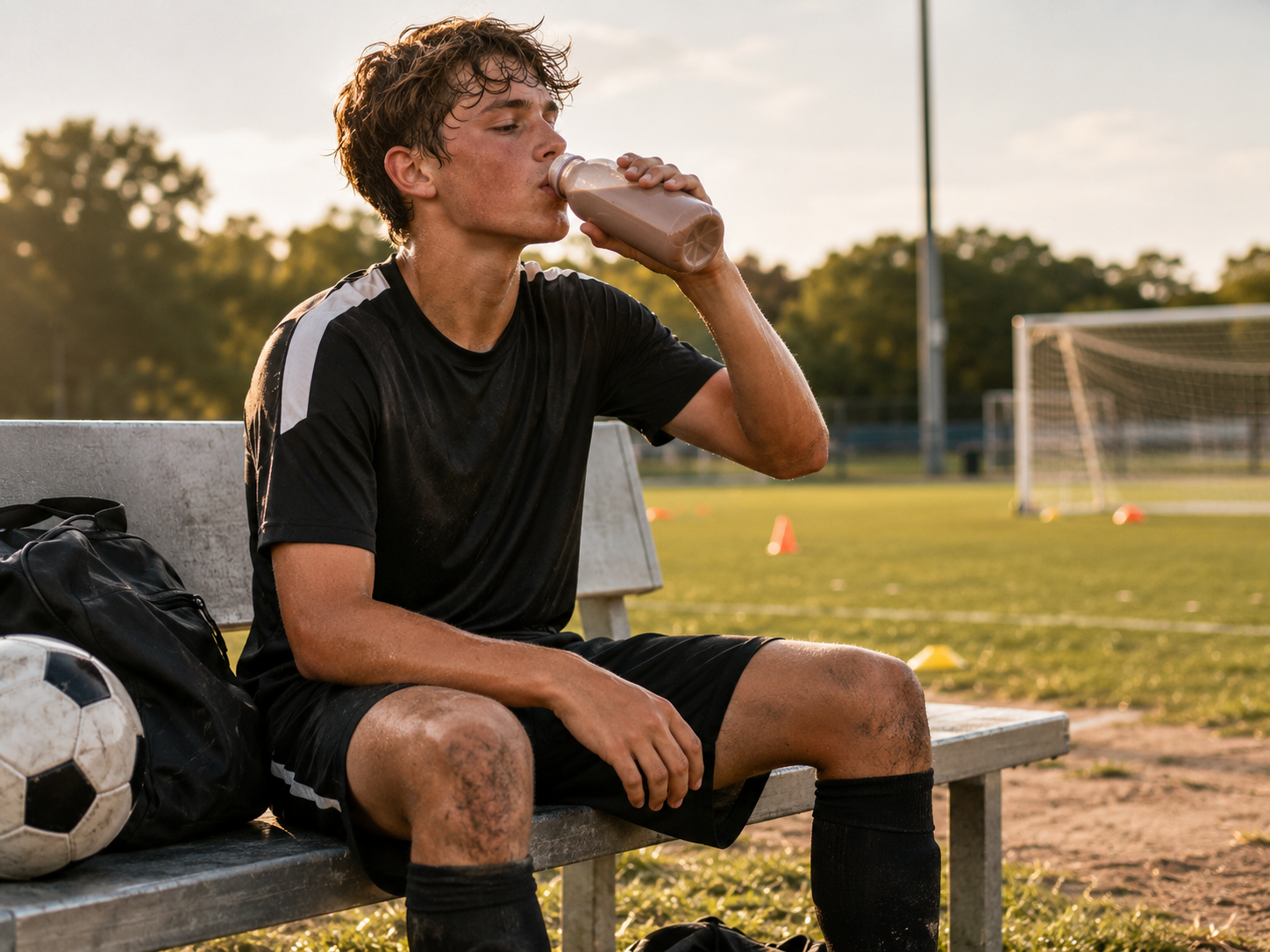
The 4-Part Recovery System Most Young Athletes Are Never Taught
Your competitive soccer player is putting in the work likely with something around five training sessions a week, weekend matches and school in between. Then with all of that by Friday they're dragging through practice, by Saturday they're fading in the 75th minute, and the gains they should be seeing from the work aren't showing up.
The pattern usually doesn't point where everyone is looking. It points to the 60 minutes after each training session.
That window decides whether the training actually turns into improvement or whether it just turns into more fatigue by tomorrow. And it's the part of competitive youth sport that almost no one teaches well, not at the club level, not at the high school level, and as the research shows, not even at the professional academy level.
This post walks through the 4-part recovery system that closes that gap.
Why Recovery Determines Whether Training Actually Counts
Recovery has a job most athletes get wrong from the start. The job isn't"feeling less sore tomorrow." Soreness is one signal of what happened during training, but it's not the goal.
The actual job of recovery is locking in adaptation which means turning the work from today's session into actual improvement by the next session. Every hard session does three things to the body: it empties out fuel stores, it damages muscle tissue, and it opens a window for the body to rebuild. What gets eaten in the hours after training is key to maximizing the body’s ability to rebuild stronger and more conditioned or whether the training just turns into fatigue, leaving the athlete to show up at the next session running on a deficit.
Multiply that decision across 4 to 6 training sessions a week and the math gets serious. A youth soccer player gets five separate recovery windows in a typical training week. Even if the training sessions aren’t quite as intense/exhausting as a match-recovery requires, missing five of the training recovery opportunities weekly creates a cumulative deficit larger than missing one match recovery.
This is where the plateaus that feel like motivation problems actually come from. The work is being done but the work just isn't being closed out.
The 60-Minute Window and What Actually Happens
The first 60 minutes after exercise is arguably the most receptive fueling window of the entire day.
A 2024 study in the Journal of the International Society of Sports Nutrition examined Premier League academy soccer players and found that those without targeted nutrition support averaged just 3.1 grams of carbohydrate per kilogram of body weight on the day after a match which is about half of the 6 to 8 grams per kilogram recommendation for that window. If 18-year-old academy professionals with team chefs and embedded education are landing at half of what they need, most youth athletes operating without that infrastructure are even further from target.
The reason the window matters comes down to how the body absorbs fuel. Right after hard exercise, muscle is in a unique state where fuel transporters are already at the surface of the muscle cell, ready to pull carbohydrate in without needing extra signals from the body. This is the body's most efficient fueling state of the day, and it operating at a higher rate for roughly the first 30 to 60 minutes after exercise.
After the first hour, the rate of fuel restoration can fall roughly in half. Your body keeps refueling, but at less than half the peak speed. A 2017 review of soccer recovery research found that delaying carbohydrate intake by just 2 hours after exercise can drop muscle glycogen levels by 45% compared to immediate refueling.
The window doesn't close like a door but it does shrink like a sponge being squeezed out. What an athlete eats in the first hour captures a fueling rate and opportunity that nothing else in the rest of the day will match.
Part 1 of the System: Carbohydrates
Carbohydrates refill the tank. After a hard 90-minute session, muscle glycogen (the storage form of carbohydrate in muscle) is significantly depleted. Replacing it fast is the first job.
The target in the first hour after training scales with body weight. Fora 130-pound athlete, aim for about 60 to 70 grams of carbohydrate. For a 150-pound athlete, around 70 to 80 grams. For a 170-pound athlete, around 80 to 90 grams. Fast-absorbing options work best in this window such as fruit, rice, potatoes, sports drinks, recovery shakes, or a real meal with starches.
Through the rest of the day after a hard session, the recommendation continues at roughly 6 to 8 grams of carbohydrate per kilogram of body weight across all meals and snacks combined. For most teenage competitive athletes, this looks like three full meals plus 2 to 3 carb-rich snacks across the day.
Part 2 of the System: Protein
Protein repairs the damage. Every hard training session creates tiny tears and damage to muscle fibers from the cutting, decelerating, jumping, and sprinting which defines soccer movement. Protein provides the building blocks that repair that damage and signal the muscle to rebuild stronger.
The target after training is 20 to 40 grams of high-quality protein (depending on player size and goals) within the first 90 minutes. That looks like a chicken breast, a serving of Greek yogurt with milk, a salmon fillet, quick protein shake or a balanced meal with meat or fish. Whey protein from milk-based drinks works fastest such as chocolate milk after training which is the classic example and is research-backed for this reason.
Across the full day, the target for a competitive young athlete is roughly 1.6 to 2.2 grams of protein per kilogram of body weight, spread across 3 to 4 meals or snacks. Pre-sleep is also valuable where 20 to 40 grams of slow-release protein, like Greek yogurt or cottage cheese, supports the muscle rebuild signal through the overnight fasting window.
Part 3 of the System: Hydration and Sodium
Hydration replaces what's lost. A 90-minute soccer match can produce fluid losses anywhere from 1 to 3 liters depending on temperature, intensity, and individual sweat rate. The target after training is to drink about 16-24 ounces of fluid for every pound of body weight lost during the session.
Sodium matters more than most athletes realize. Sweat carries significant amounts of sodium out of the that needs to be replaced. Plain water alone leaves the body too fast, increasing urine output and slowing recovery. Sports drinks, milk-based recovery drinks, or salted food paired with water all work better than water alone in the immediate post-exercise window. This both replaces the sodium lost and is able to help the body absorb/retain the fluid being consumed.
A useful detail: milk-based drinks have measurably higher fluid retention than water and most sports drinks. The combination of fluid, sodium, carbohydrate, and protein in a single container is why chocolate milk consistently shows up in recovery recommendations.
Part 4 of the System: Next-Day Fueling
Recovery doesn't end at bedtime. The day after a hard match or training session, the body is still rebuilding and the carbohydrate and protein the athlete eats across that day determines whether the rebuild is complete by the time the next session arrives.
This is where the Premier League academy data becomes useful. Even with team support, academy players landed at 3.1 grams of carbohydrate per kilogram on match-recovery days which is far below the 6 to 8 gram target. Without infrastructure, the gap widens. For most youth athletes, the day-after deficit is the largest hidden cause of mid-season plateaus.
The simplest framework for the day after a hard session: three full meals built around carbohydrates plus protein plus colorful vegetables, with 2 to 3 carb-rich snacks across the day. Steady fueling beats heroic single meals.
A Real-World Application
Consider a 150-pound club soccer player who finishes a hard 90-minute training session at 7 PM on a Tuesday.
Within 30 minutes of finishing, by 7:30 PM, the athlete reaches for chocolate milk in the car ride home. Fast carbs, fluid, sodium, and protein, all in one container. A 16-ounce serving delivers about 50 grams of carbohydrate and 16 grams of protein.
Within 90 minutes of finishing, by 8:30 PM, the athlete sits down to areal meal. As an example, the classic chicken breast, rice, roasted vegetables can be perfect here. About 80 grams of carbohydrate and 30 grams of protein, with continued fluid through the meal. The window is now closed properly.
Through the evening continuing to have water with dinner, water through homework, and a small carb-and-protein snack before bed. Greek yogurt with berries works well as the slow-release protein for the overnight rebuild window.
The next day the three full meals are built around starches with protein, two carb-rich snacks between meals, water across the day. The Wednesday session then lands on legs that are actually ready.
Without the system, the same 7 PM finish often goes like this: drive home, snack on whatever's around at 8:30, eat real dinner at 9:15, water mostly skipped, no pre-sleep protein, light breakfast Wednesday morning, and a flat Wednesday session that the coaching staff misreads as effort. The work is being done but that same work just isn't being closed out and capitalized on.
Frequently Asked Questions
What should my soccer player eat right after a hard training session?
The first 30-60 minutes is the highest-priority window. Aim for a mix of fast-absorbing carbohydrates plus some protein and sodium. Chocolate milk, a fruit smoothie with Greek yogurt, a sports drink paired with a granola bar, or pretzels with deli turkey all work well. The key is something with protein, carbs and a little salt within the first half hour.
How much carbohydrate does a teenage athlete need after practice?
For a competitive young athlete, aim for roughly 60 to 80 grams of carbohydrate in the first hour after a hard session, scaling up for larger bodyweight. Across the full day after hard training or on match days, total carbohydrate intake should land around 6 to 8 grams per kilogram of bodyweight. For a 60-kilogram athlete (about 132 pounds), that's roughly 360 to 480 grams across all meals and snacks combined.
Is chocolate milk really a good recovery drink for athletes?
Yes, and it's research-backed for a reason. Milk-based drinks have higher fluid retention than water or many sports drinks, and chocolate milk delivers carbohydrate, protein, fluid, and sodium in one container. A 16-ounce serving provides roughly 50 grams of carbohydrate and 16 grams of protein, which is a strong first-fuel option after a hard session. Pair it with a real meal within 90 minutes for full recovery.
How long after training does my athlete have to eat?
The most receptive fueling window is the first 30 to 60 minutes. Waiting 2 hours can reduce muscle recovery by approximately 45%. The fix doesn't require a full meal in 30 minutes as even a smoothie, sports drink with a snack, or chocolate milk in the car ride home is enough to keep the window working in the athlete's favor, with a full meal following within 90 minutes.
Does my athlete need a sports drink after every practice?
Not after every practice, but after hard 90-minute sessions or matches in warm conditions, yes. Sports drinks deliver the sodium, fluid, and carbohydrate combination that plain water alone can't match efficiently. For shorter, lower-intensity sessions in cool weather, water and food cover most of what the body needs.
Should my competitive athlete work with a sports dietitian on recovery?
If your athlete is training 4 to 6 days a week and not seeing the gains they should, or are showing the symptoms of incomplete recovery (flat midweek practices, late-match fade, unexplained plateaus), working with a Board Certified Specialist in Sports Dietetics can identify exactly which part of the recovery system is the biggest gap. The 4-part framework above is the starting point. Personalized application is where it gets dialed in for an individual athlete's training load, body weight, and life schedule.
----------
If your athlete is putting in the training and not seeing it translate the way it should, the recovery system is usually the missing piece. The free 15-minute Discovery Call is built to identify which part of the system is your athlete's biggest gap and what to do about it. Book here
Jay Short, MS, RD, CSSD is a Registered Dietitian and Board Certified Specialist in Sports Dietetics, and co-owner of Rise Nutrition, specializing in sports dietetics for competitive athletes. He works with US Soccer (all 27 teams), the Columbus Blue Jackets (NHL), and athletes across MLS, collegiate, and club programs.
-----------
References
- Carter J, Healy R, Hardman B, Loosemore M. Contemporary educational and behavior change strategies improve dietary practices around a match in professional soccer players. Journal of the International Society of Sports Nutrition. 2024. https://pubmed.ncbi.nlm.nih.gov/39233490/
- Ranchordas MK, Dawson JT, Russell M. Practical nutritional recovery strategies for elite soccer players when limited time separates repeated matches. Journal of the International Society of Sports Nutrition. 2017;14:35. https://pubmed.ncbi.nlm.nih.gov/28919844/
- Naderi A, de Oliveira EP, Ziegenfuss TN, Willems MET. Nutritional Strategies to Improve Post-exercise Recovery and Subsequent Exercise Performance: A Narrative Review. Sports Medicine. 2025. https://pubmed.ncbi.nlm.nih.gov/40117058/
- Alghannam AF, Gonzalez JT, Betts JA. Restoration of Muscle Glycogen and Functional Capacity: Role of Post-Exercise Carbohydrate and Protein Co-Ingestion. Nutrients. 2018;10(2):253. https://pubmed.ncbi.nlm.nih.gov/29473893/
- Craven J, Desbrow B, Sabapathy S, Bellinger P, McCartney D, Irwin C. The Effect of Consuming Carbohydrate With and Without Protein on the Rate of Muscle Glycogen Re-synthesis During Short-Term Post-exercise Recovery: A Systematic Review and Meta-analysis. Sports Medicine - Open. 2021;7(1):9. https://pubmed.ncbi.nlm.nih.gov/33507402/

Ready to Take Your Nutrition
to the Next Level?
Stop guessing and start getting results. Book a free discovery call
to find the right coaching program for your goals.