
The Part of Going to College No One Warns Soccer Players About
You committed! You know the school, the coach, the roommate you got matched with. You have probably already pictured the first day of preseason a hundred times.
Now try to answer a smaller question. On a day training runs long and you finally get free at 8pm, what are you going to eat?
For a lot of college-bound athletes, that is where it goes quiet. And that quiet is worth paying attention to, because the answer to that one question has more to do with how your first year goes than almost anything on your packing list.
The Thing That Actually Changes
Here is what nobody sits you down and explains. In high school, your day runs on rails someone else built. Training is at a set time, meals show up at set times with most of them handled at home and if practice ran late, there was usually food waiting when you walked in the door. You did not have to think about the timing, because the timing was somebody else's job.
In college, you lay your own track. Class schedules jump around from one day to the next, training shifts, the meal room has hours which do not bend around your session and the food that used to appear is now something you need to plan for, shop for, and pull together yourself.
That single shift is the root of nearly every fueling problem first-years run into. The skipped breakfast before an early lift. The recovery window that closes because you could not get to food in time. The meal tray loaded with the fun dessert stuff and light on everything else. None of those are really about willpower or discipline. They trace back to one change: the structure that used to feed you is gone, and keeping yourself fueled is now on you.
Most athletes feel it within the first full day of juggling training and classes at once, when it hits them how much was quietly being handled all along.
Two Ways the Dining Hall Trips People Up
The dining hall deserves its own warning, because it fails athletes in two opposite ways depending on the school.
At a big program with endless options, the problem is abundance. There is a dessert station, maybe an ice cream machine that never turns off, ten things that all sound good. It becomes easy to load up on the fun stuff and leave the plate half-built, light on the protein and the fruit and vegetables that actually carry the training load. The food itself is not the issue. The issue is the plate that never gets fully built because the fun options are the loudest ones in the room.
At a smaller program, the problem flips. Meals are available at set locations at set times, and if your training does not line up with those windows, the room is simply closed. Now you are left to fend for yourself, which usually means fast food, whatever you can scrape together, or nothing at all, right when your body just finished its hardest work of the day. That one is not a choice problem. It is a structure problem, plain and simple.
Knowing which version your school leans toward is genuinely useful before you get there. But the fix for both starts from the same place, and it is the thing worth building this summer.
Not All Programs Support You the Same Way
There is an assumption I run into over and over with the athletes I work with. They commit somewhere, they find out the school has a sports dietitian on staff, and they relax. Nutrition is handled.
Then they arrive and it clicks. That dietitian is responsible for the entire athletic department, hundreds of athletes across every team, plus all the logistics that come with feeding them. What the athlete pictured was someone who knew their schedule, their body, where they were in their season. What actually exists is one person covering far more ground than any individual can.
This is not a knock on anyone. It is the math of how these roles are built and the research backs up how uneven the setup is from school to school.A 2022 Interassociation Consensus Statement in the Journal of Athletic Training laid out that collegiate programs deliver nutrition through four different staffing models. Provision varies substantially from one program to the next, and the statement named sports dietitians and board-certified specialists as the preferred providers. In plain terms: support is real, but it is nowhere near standardized. What you get at a major program with sponsorship money and a full training table looks nothing like what you get at a smaller school with one dietitian stretched across every sport.
The gap shows up most clearly at the Division III level. In 2014 the NCAA changed its rules to let schools feed athletes more freely. A 2025 study in theJournal of American College Health found that this change drove a wave of dietitian hiring across athletic departments, everywhere except Division III. There, food access stayed a documented, real problem for athletes. So the level you are heading to genuinely shapes what is provided for you.
Here is the part that surprises people most. Not the big program. Not the small one. It is that even at the most well-resourced schools, the athlete-to-dietitian ratio is high enough that it is easy to fall through the cracks. A 2021 narrative review in Nutrients reported that the number of full-time dietitians serving college athletes more than quadrupled in the decade leading up to that review. Even so, many student-athletes still fell short on fuel, and some overshot. More support than ever, and the gaps did not close. Which tells you something worth holding onto: the support around you helps, but it was never going to do the job for you. The skill has to be yours.
The One Skill That Survives Any Program
If there is a single thing worth walking onto campus already knowing how to do, it is not a meal plan. It is being able to feed yourself when no one is doing it for you.
That moment comes sooner than most expect. The one I watch catch athletes off guard is break periods. There is optional or required training over a holiday stretch, so you are still on campus, but everyone else has gone home and most of the dining spots are closed. Food exists around the training itself, but the rest of campus is a ghost town, and suddenly getting a real meal is a lot harder than it was all semester. That is the first true test of whether you can handle food on your own.
The skill that carries you through it, and through any program at any level, is almost boring in how basic it is. Building a grocery list. Getting through a store without wandering for an hour. Cooking a few meals you can lean on without a recipe in front of you. And storing that food safely so it does not spoil and put you out of training for three days.
That last one gets overlooked constantly, and it matters more than people think. Food that sits out too long, leftovers no one dated, a fridge packed wrong. Getting sick from your own kitchen costs you training days the same way a tweaked hamstring does. Learning basic food safety is not glamorous, but it is part of the same skill set, and it is one almost nobody arrives with.
The best part is that every piece of this can be built right now, before you need it under real pressure.
Why the Summer Before Is the Whole Opportunity
You do not learn a fire drill during the fire. You practice it beforehand, so when it matters your body already knows what to do. Feeding yourself works the same way.
Right now, these weeks before you leave, is practice with nothing on the line. Your kitchen. Your schedule. No stakes. If you skip it and try to figure it out during preseason instead, you are learning the hardest new life skill of your life during the hardest weeks of your year, while classes start, training ramps up, and everything is unfamiliar all at once.
And that ramp is real. Preseason volume climbs fast, often faster than anything you did in high school. Your body starts asking for more fuel at the exact moment the structure that used to feed you has vanished. That collision is a big part of why so many first-years feel flat those opening weeks, and it gets blamed on nerves or conditioning when a lot of it is simply not eating enough for the work.
Doing the prep now is simple by comparison. Make a grocery run. Cook a couple of meals. Get two or three reliable options down cold. A bowl you buildon a base you cook in bulk. Eggs any way you like them. A one-pan protein and vegetable. Learn to build a plate the same way every time, so it holds up even in a dining hall full of distractions. Then you arrive with it handled instead of scrambling when your plate is already full.
What This Looks Like in Practice
You do not need a rigid plan you will abandon by week two. The goal is knowing your own setup. When will you realistically eat on a long-training day? What will you keep on hand for the gaps? What is your move when the meal room is closed and you are starving after a session?
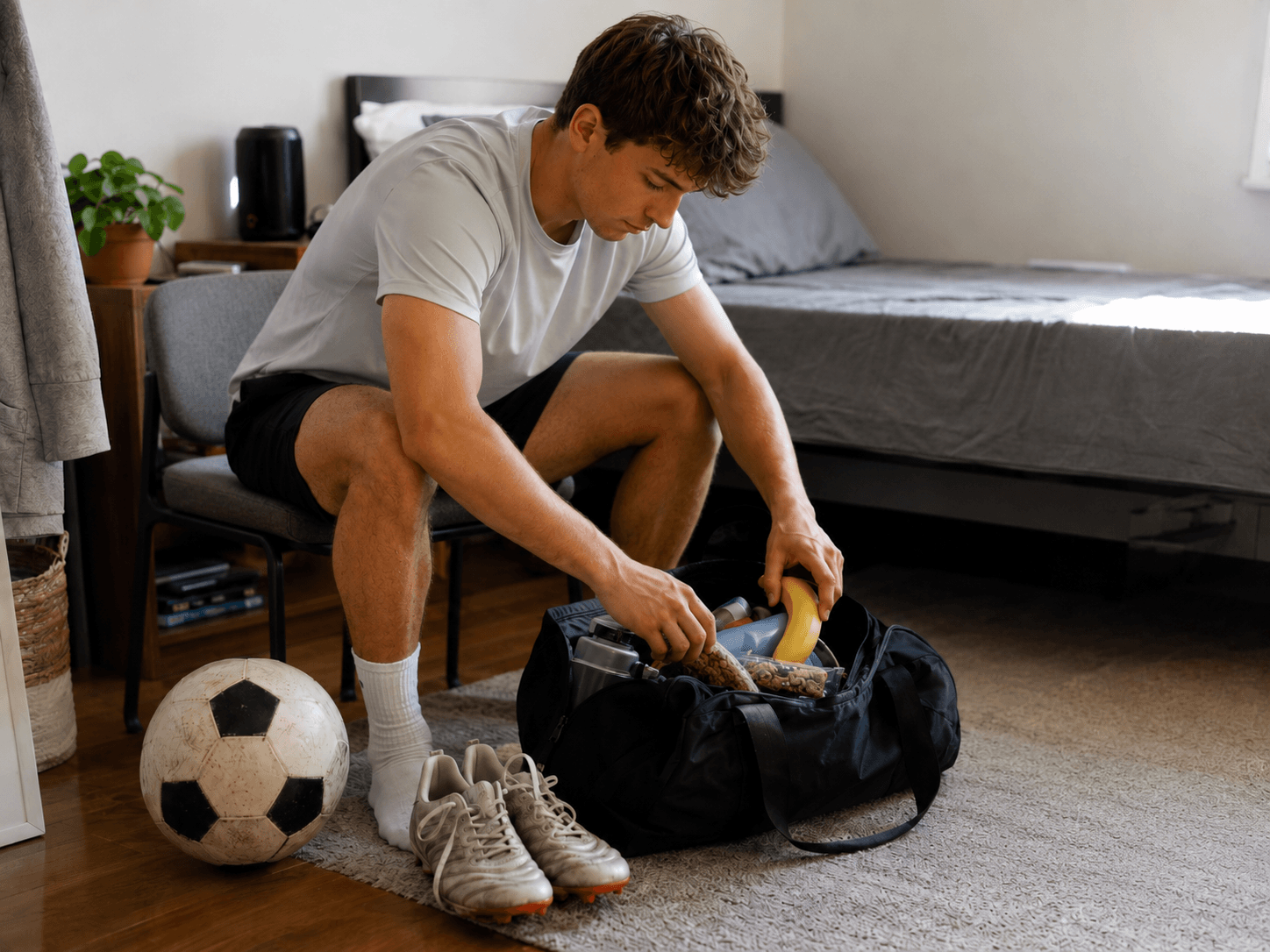
A backup in your bag covers the closed-window nights: a piece of fruit, a protein you tolerate well, something to drink. A short list of meals you can actually cook covers the days you are on your own. And a plate you know how to build on autopilot covers the dining hall, whether it is overflowing with options or short on them.
Feeling a little unready for all of this is not a red flag. Almost no-one prepares you for it, so noticing it now actually puts you ahead of most of the athletes moving in alongside you. You do not have to solve everything before you go. Starting with one piece is enough.
-----------
Frequently Asked Questions
When does the fueling actually get hard for a college athlete?
It usually gets hard within the first full day or week of combining training with a real class schedule. That is when athletes realize how much timing was being handled for them, because no two days look the same and the food no longer just appears.
Is the "freshman 15" a real thing athletes should worry about?
Not really. The "freshman 15" is a general-population idea that is largely overstated and not specific to athletes. It is more useful to set it aside and focus on the real issue, which is that the structure previously feeding you changes overnight while your fueling needs go up at the same time. Those experiencing the “freshman 15” tend to be those falling into the trap of a larger dining hall with abundant options and filling up on the ‘fun’ items and not the things that will properly fuel you.
My kid's school has a sports dietitian. Isn't nutrition handled?
Having a dietitian on staff and having one focused on your athlete are two different things. That person is often responsible for hundreds of athletes across an entire department. The support is real, but it is spread thin, and the athletes who do best still arrive able to handle the basics themselves.
What is the single most useful thing to do the summer before leaving?
Learn to shop, cook a few reliable meals, and store food safely. Every athlete eventually lives off campus and needs these, and building them now, while the kitchen is familiar and the stakes are low, means they are automatic by the time they matter.
How do I know if my athlete is actually ready for this transition?
The simplest test is the long-training-day question: can they tell you exactly how they would eat on a day their session runs late and the dining hall is closed? If the answer is a shrug, that gap is worth closing before move-in, and it is exactly what a short Discovery Call is built to map out.
-----------
If your athlete can't yet answer how they'll eaton a long-training day, that gap is worth closing before move-in, not during week one. The free 15-minute Discovery Call is where we determine what those primary challenges are and how we can address them together. Book Your Discovery Call
Jay Short, MS, RD, CSSD is a Registered Dietitian and Board Certified Specialist in Sports Dietetics, and co-owner of Rise Nutrition, specializing in sports dietetics for competitive athletes. He works with US Soccer (all 27 teams), the Columbus Blue Jackets (NHL), and athletes across MLS, collegiate, and club programs.
-----------
References
- Lambert V, Carbuhn A, Culp A, Ketterly J, Twombley B, White D. Interassociation Consensus Statement on Sports Nutrition Models for the Provision of Nutrition Services From Registered Dietitian Nutritionists in Collegiate Athletics. Journal of Athletic Training. 2022;57(8):717-732. https://pubmed.ncbi.nlm.nih.gov/36356618/
- Lenz EK, Wade C, Starkoff B, Shearer A. Athlete-Sports Nutrition Access Questionnaire (A-SNAQ): Predictors of food insecurity among Division III Collegiate athletes. Journal of American College Health. 2025;73(10):3757-3761. https://pubmed.ncbi.nlm.nih.gov/39889222/
- Riviere AJ, Leach R, Mann H, Robinson S, Burnett DO, Babu JR, Frugé AD. Nutrition Knowledge of Collegiate Athletes in the United States and the Impact of Sports Dietitians on Related Outcomes: A Narrative Review. Nutrients. 2021;13(6):1772. https://pubmed.ncbi.nlm.nih.gov/34067402/
- Reed JL, De Souza MJ, Kindler JM, Williams NI. Nutritional practices associated with low energy availability in Division I female soccer players. Journal of Sports Sciences. 2014;32(16):1499-1509. https://pubmed.ncbi.nlm.nih.gov/24787233/

Ready to Take Your Nutrition
to the Next Level?
Stop guessing and start getting results. Book a free discovery call
to find the right coaching program for your goals.