
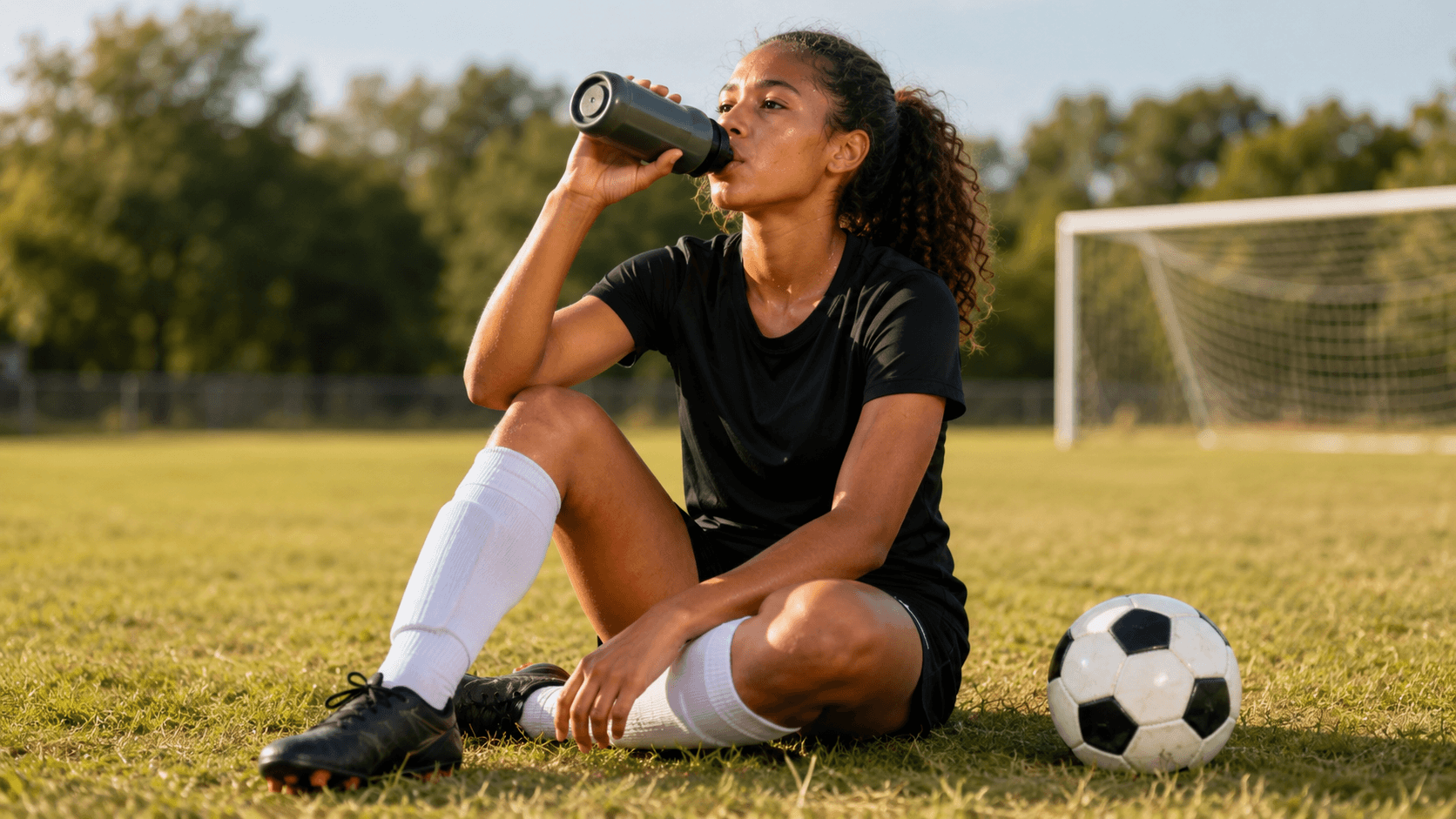
Do Youth Soccer Players Really Need Electrolyte Packets? A Sports Dietitian's Honest Answer
Walk the sideline of any summer soccer tournament and you will spot them everywhere. Brightly colored electrolyte packets tucked into every bag, stirred into every water bottle, passed around the team tent like they are the one thing standing between a player and a cramp. The marketing has done its job. It has convinced a generation of athletes and parents that you are always a little bit depleted and always one packet away from fixing it.
If you are a parent trying to figure out whether these are worth the money, or an athlete wondering if you actually need them, this is the honest version from someone who does this for a living. Electrolytes are real, and they matter. But most young soccer players need them far less often than the ads suggest, and knowing the difference can save you money and a lot of second-guessing. Let me walk you through what your body actually does with sweat, which electrolytes truly matter, and the specific situations where a packet earns its place.
Why your body loses electrolytes in the first place
Sweat is not just water leaking out to cool you down. It carries salt with it. As it forms deep in the sweat gland, sweat looks a lot like the watery part of your blood. On the way up to the skin, your body pulls some of the salt back into the bloodstream, a process sports scientist Lindsay Baker has mapped in the journal Temperature. So what lands on your skin is salty, but less salty than your blood.
One detail from that process explains almost everything about this topic: the faster you sweat, the less time your body has to reclaim that salt, so a hot, all-out session drains more water and more salt than an easy one. That is why a light technical practice and a brutal two-a-day in August are not the same hydration situation, even for the same player.
So the reason we care about electrolytes at all is simple. Hard training in the heat pulls both fluid and salt out of you, and at some point that is worth replacing. The real question is not whether you lose electrolytes. You do. It is how much, when, and whether a packet is the right tool for the job.
Which electrolytes do you actually lose in sweat?
Most packets proudly list a lineup of electrolytes: sodium, potassium, calcium, magnesium, and often more. The label implies you are draining all of them in equal measure every time you train. Your sweat tells a different story.
Sweat is overwhelmingly water and sodium chloride, which is ordinary salt. Potassium shows up in smaller amounts, and calcium and magnesium are present in only tiny traces. All of these minerals matter enormously for how your body works. The difference is how you replace them. Potassium, calcium, and magnesium are day-to-day nutrients your body tops up from normal meals, so foods like fruit, potatoes, dairy, beans, nuts, and leafy greens do that job quietly in the background. Sodium is the one electrolyte you lose in a large enough amount during a session to think about replacing around training.
That one fact changes how to see these products. When a label brags about five electrolytes, only one of them leaves your body fast enough to plan around. The rest are covered by normal eating, not a mid-game drink.
Every athlete is different: meet the salty sweater
Here is where the one-size-fits-all packet really falls apart. There is no universal electrolyte number, because how much you sweat and how salty that sweat is vary dramatically from person to person. A large analysis of more than 1,300 athletes published in the Journal of Sports Sciences found that the average athlete loses roughly 800 milligrams of sodium in every liter of sweat, but the range between individuals was nearly eightfold. Two teammates in the same game, in the same weather, can have wildly different needs.
How to tell if you run salty
You do not need a lab to get a rough read on your own sweat. A few practical signs point to a heavy, salty sweater: white streaks or crusty rings on your shirt and skin after training, sweat that stings your eyes, and sweat that tastes noticeably salty. Parents, the laundry gives it away too. Stiff, white-streaked jerseys after a hot session are a telltale sign. If that sounds like you or your athlete, sodium is worth more attention on hard days. If it does not, your needs are probably more modest than the marketing assumes.
A simple way to learn your pattern
For athletes who want to get more precise, there is an easy at-home check used across sports: weigh yourself right before a hard session and again right after, while keeping rough tabs on how much you drink during the session itself. The drop on the scale is primarily fluid you lost, and it gives you a real sense of how much you need to replace next time. Do it on a hot day and a mild day and you will start to see your own pattern instead of guessing.
So when does a packet actually help?
None of this means packets are useless. It means they are a tool for specific situations rather than a daily habit. A full electrolyte packet earns its place when:
- You are training long and hard in the heat, like preseason two-a-days where you finish soaked and salt-crusted.
- You are playing multiple games in a day at a tournament, where fluid and salt losses stack up across the weekend.
- You already know you are a heavy, salty sweater.
- You are trying to rehydrate quickly between two same-day sessions or games, since a little sodium helps your body hold onto the fluid you drink instead of passing it straight through.
And it is mostly unnecessary on ordinary days: short or easy sessions, mild weather, or everyday sipping at school or on the couch. On a normal day, eating regular meals with some salt and drinking throughout the day generally has you covered. A salty snack or a normal sports drink handles anything extra for a fraction of the price of a specialty packet.
Do electrolytes actually stop cramps?
This is the belief that keeps a lot of packets selling: cramp up, and you must be low on electrolytes. The evidence is more nuanced. Research in the British Journal of Sports Medicine found that blood electrolyte levels and hydration status often do not separate the athletes who cramp from the ones who do not. The bigger driver of most cramps is simply tired, overworked muscles late in a game.
There is a real exception. A specific group of heavy, salty sweaters who also under-eat salt do cramp less when they pay attention to sodium and fluid, and that pattern is well documented in tennis players competing in the heat. So the accurate takeaway is that cramps are mostly a fatigue and conditioning story, and sodium is the answer for a specific minority rather than a reliable fix for everyone. Chugging a packet is not a dependable cramp cure for the average player.
Can you drink too much? The flip side nobody markets
The electrolyte trend tends to push a "more is always better" mindset, and that is worth pushing back on. You can absolutely overdo fluid. Drinking far too much plain water in a short window can dangerously dilute the sodium in your blood, and at the extreme that becomes a medical emergency. An international panel of sports medicine experts studied this exact problem. Their conclusion: the main cause of that dangerous drop in blood sodium is drinking too much plain fluid, rather than losing salt.
For the vast majority of young athletes, the practical message is reassuring: you do not need to force down gallons to prove you are hydrated. Drinking to thirst across the day, with a little more attention on hot and heavy days, is a safe and effective default. More water and more packets is not automatically safer.
Why fitter, heat-adapted athletes need fewer electrolytes
One last piece that the marketing gets exactly backward. As you get used to training in the heat over a couple of weeks, your body actually gets better at holding onto salt. A 2018 study in the Journal of Thermal Biology showed that as athletes adapt to the heat, the amount of salt in their sweat drops steadily, day after day. In plain terms, the fitter and more heat-adapted you become, the less salt you lose in your sweat. So your need for added sodium tends to go down over a season, not up. Showing up for those tough early hot sessions pays you back later.
The bottom line: your simple game plan
If you strip away the marketing, a sensible approach for most youth soccer players comes down to a few habits. Build the foundation with food first, salting your meals normally and eating a balanced plate, because that quietly covers most days. Add real fluid and some sodium on the hot, long, heavy-sweat days, whether that comes from a salty snack, a normal sports drink, or yes, a packet when the day calls for it. And learn your own body, since a heavy salty sweater and a light sweater should not be following the same plan.
Match the tool to the day and to the athlete, and you will spend less, guess less, and show up better fueled for the games that matter.
-----------
Frequently Asked Questions
Do youth soccer players need electrolyte drinks every day?
For most young players, no. On a normal training day, water and regular meals cover what you lose in sweat. Electrolyte drinks and packets matter mainly for long, hot, heavy-sweat sessions and multi-game tournament days.
Are electrolyte packets bad for kids?
No, they are not harmful for healthy young athletes. They are simply a tool that fits some situations and not others. The mistake is using a concentrated packet every day out of habit rather than saving it for the hot, heavy days when it actually helps.
Do electrolytes prevent muscle cramps?
Sometimes, for a specific group of heavy, salty sweaters who also under-eat salt. For most athletes, cramps trace back to muscle fatigue rather than a missing electrolyte, so a packet is not a reliable cramp cure on its own.
Is it possible to drink too much water before a game?
Yes. Slamming a large amount of plain water right before kickoff tends to slosh, get urinated out, and in extreme cases can dilute your blood sodium. Sipping steadily starting the night before, with a little salt on your food, works far better than chugging at kickoff.
How do I know exactly how much my athlete should be drinking?
Every athlete's sweat rate and sodium losses are different, so the best plan is a personalized one built around your athlete's position, sweat pattern, and schedule. If you want help mapping that out, a sports dietitian can build a simple, individualized hydration and fueling plan so you are not guessing from a label.
-----------
Not sure whether your athlete is a salty sweater who needs more sodium, or someone who is fine on water and food? That is the kind of thing a free 15-minute Discovery Call is for. We will talk through where your athlete is at, and figure out whether working together is the right fit and how I can best support them: Book Your Discovery Call
Jay Short, MS, RD, CSSD is a Registered Dietitian and Board Certified Specialist in Sports Dietetics, and co-owner of Rise Nutrition, specializing in sports dietetics for competitive athletes. He works with US Soccer (all 27 teams), the Columbus Blue Jackets (NHL), and athletes across MLS, collegiate, and club programs.
-----------
References
1. Baker LB. Physiology of sweat gland function: The roles of sweating and sweat composition in human health. Temperature (Austin). 2019;6(3):211-259. https://pubmed.ncbi.nlm.nih.gov/31608304/
2. Barnes KA, Anderson ML, Stofan JR, Dalrymple KJ, Reimel AJ, Roberts TJ, Baker LB. Normative data for sweating rate, sweat sodium concentration, and sweat sodium loss in athletes: An update and analysis by sport. J Sports Sci. 2019;37(20):2356-2366. https://pubmed.ncbi.nlm.nih.gov/31230518/
3. Schwellnus MP. Cause of exercise associated muscle cramps (EAMC): altered neuromuscular control, dehydration or electrolyte depletion? Br J Sports Med. 2009;43(6):401-408. https://pubmed.ncbi.nlm.nih.gov/18981039/
4. Buono MJ, Kolding M, Leslie E, Moreno D, Norwood S, Ordille A, Weller R. Heat acclimation causes a linear decrease in sweat sodium ion concentration. J Therm Biol. 2018;71:237-240. https://pubmed.ncbi.nlm.nih.gov/29301696/
5. Hew-Butler T, Loi V, Pani A, Rosner MH, et al. Statement of the Third International Exercise-Associated Hyponatremia Consensus Development Conference, Carlsbad, California, 2015. Clin J Sport Med. 2015;25(4):303-320. https://pubmed.ncbi.nlm.nih.gov/26102445/

Ready to Take Your Nutrition
to the Next Level?
Stop guessing and start getting results. Book a free discovery call
to find the right coaching program for your goals.