
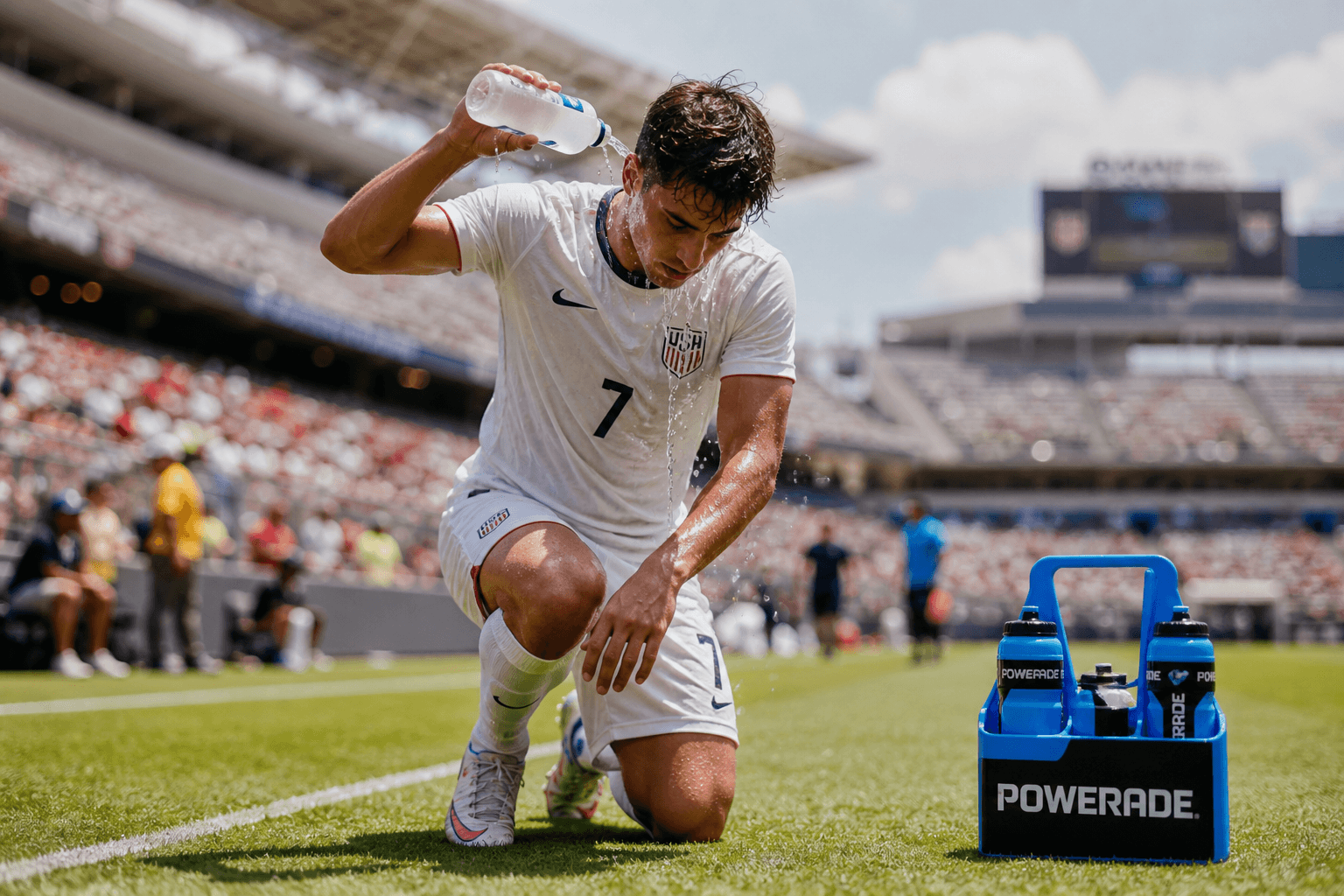
Heat Acclimation for Soccer Players: Why May Is the Sneaky-Hard Month
Your soccer player has been training hard all spring. Their fitness is real, they feel good in practice, they are running well, and the work they have put in is paying off.
Then the first warm-weather tournament hits and by the second half they look heavy-legged. The sprints they were nailing two weeks ago are not there.The recovery between matches feels different than it did in March. Something is off, and most families assume it is bad luck or just an off-day.
It is not. It is a window of preparation that almost no one talks about, and the good news is that you can close it in about two weeks.
Fitness and heat tolerance are two completely separate things your body builds, and your soccer player has only built one of them so far. Here is what is actually happening, what the research shows, and exactly what to do before showcase season, state cup, and summer ID camps.
Fitness and Heat Tolerance Are Two Different Adaptations
When your soccer player trains in cool spring weather, they are building aerobic capacity, endurance, and sprint output. All of that is real and it shows up on the field.
What they are not building is the body's ability to handle heat. That requires a separate set of changes that only happen when the body is actually exposed to warm conditions: better sweating efficiency, lower heart rate at the same effort level in heat, expanded blood volume, and a slower rise in body temperature during competition. None of that develops in 50-degree practice sessions.
This gap shows up every May. Athletes are physically ready to compete but their bodies have not seen real heat in eight months. Their first warm-weather match is the first time their cooling system has been tested all year, and the body responds the way an unprepared system always responds. Performance drops, recovery slows and the same player who looked sharp in March looks flat in May.
This is not a fitness problem, it is a separate adaptation that needs its own preparation window.
What the Research Shows About Performance Loss in the Heat
A study on semiprofessional soccer players measured what happens when athletes compete in warm conditions without prior heat acclimation. They found that their high-intensity running dropped 16% in the heat compared to cool-weather match play and total distance covered dropped about 6%.
Those numbers translate directly to what college coaches evaluate at showcases and ID camp evaluations. The repeat sprints in the second half, the defensive recovery runs at minute 75 and the pressing intensity that separates a starter from a substitute. All of those outputs are heat-sensitive, and all of them drop first when the body has not adjusted to warm conditions.
A study cited in the international sports medicine consensus on training in heat compared two triathlon races held two months apart in similar conditions. The first race, held in unseasonably warm weather at the start of summer, produced 15 cases of exertional heat illness including three heatstrokes. The second race, run in identical environmental conditions, produced zero cases. The only variable that changed was whether athletes had time to seasonally adjust to the heat. While we aren’t all triathletes the concept/findings are universally impactful.
That is the May window in soccer. Same body, same fitness, same conditions in many cases. Wildly different outcomes depending on whether the body has caught up to the calendar.
Heat Acclimation Improves Performance Even on Cool Days
Here is the part that surprises most parents and athletes. Heat training does not just protect performance in warm conditions. It actively improves performance across the board.
Research on trained athletes who completed 10 days of heat acclimation showed time-trial performance improved 6% in cool conditions and 8% in hot conditions. They found that their hearts became more efficient, blood volume expanded and power output at lactate threshold improved in both environments. Every measure of performance went up regardless of game-day temperature.
This reframes how families should think about heat preparation. It is not just a defensive strategy to avoid bad outcomes in warm weather. Rather, it is an offensive training stimulus that produces measurable upgrades in fitness and performance, with carryover gains that show up on cool days too. Athletes who put in the work during May are walking into summer competition with a real edge over athletes who do not.
How Long Heat Adaptation Actually Takes
The expert consensus on training in heat, published by an international panel of sports medicine researchers, lays out a clear timeline. Most adaptations begin within the first week of regular heat exposure. Near-complete cardiovascular and sweating adaptations are in place by days 6 to 10. Full optimization of aerobic performance in heat takes about two weeks.
There is one important nuance for soccer players who competed through last summer. The body retains a memory of previous heat adaptation, and re-acclimation happens faster than first-time acclimation. This is great meaning your athlete is not starting from zero in May and that they have a head start, and that head start shortens the window.
The practical target: two weeks of intentional outdoor warm-weather training before the first high-stakes warm-weather event. Work backwards from whatever is on the calendar. State cup in late May means starting now. Summer ID camp in late June means starting in early June. The body needs the actual exposure to do the work. There is no shortcut, and there is no substitute for real outdoor sessions.
Hydration Status Before the Game Matters More Than You Think
A lot of the attention around game-day hydration goes to what athletes drink at halftime or on the sideline. The research points to a different lever entirely.
A study on young elite soccer players, average age 17, split players into two groups before a friendly match. One group was found to be starting slightly dehydrated and the other was coming in properly hydrated. Both groups played at identical intensities throughout with similar heart rates and overall similar physical output. The dehydrated group showed a 28% higher cortisol response after the match. The well-hydrated group showed no significant change.
Cortisol is the body's primary stress hormone. Some post-match elevation is normal because the body just worked hard. But a 28% higher response means the body registered the match as a much bigger physiological stressor than it actually was. The downstream effects are slower muscle repair, longer recovery time, and a deeper stress load heading into the next training session or game. Across a tournament weekend with multiple matches, that response stacks. Your athlete is starting game two in a worse position than game one, and the gap widens through the weekend.
What is striking about this finding is that the "mildly dehydrated" group was not severely affected by appearances. They were not visibly struggling, not extremely thirsty, not dragging through warmup. They were simply not topped off from the morning. That’s the kind of dehydration that does not feel like anything is happening but is still meaningfully shifting how the body responds to competition.
So the question becomes: how do you actually know where your athlete stands before they leave the house?
The Morning Urine Color Check
First-morning urine is the most reliable, most accessible daily hydration check available to any athlete. Pale yellow means they are starting the day in a good position. Dark yellow or amber means they are already behind, and they only have a few hours before warmup to catch up.
A study on young athletes attending a summer training camp found that over 90% arrived to their first session already dehydrated. The study population was youth volleyball and basketball athletes, but the principle applies broadly across competitive youth sports. The deficit did not develop on the field, it came from home. Most of those athletes had no idea they were starting behind because the body's thirst signal does not flag mild dehydration well.
Building this check into the morning routine is one of the simplest, highest-impact behavior changes you can make as a soccer family. Before breakfast, before checking the phone, before anything else. Ten seconds and a color read. Over a 14-day period this becomes automatic, and your athlete builds awareness of their own patterns and what their body actually needs to start the day in a good position.
Individual Sweat Rate Variation and Why Team Rules Miss the Mark
Once your athlete has the daily hydration check in place, the next layer is understanding their own individual fluid losses during training and competition. This is where blanket team-wide guidelines start to break down.
Sweat rate is one of the most individually variable things in sports performance. Two players on the same team in the same match in the same heat can lose dramatically different amounts of fluid. Body size, genetics, fitness level, and current heat adaptation status all play a role. Sweat rates during match play are also roughly double what most players experience in training, which means a team rule based on practice realities consistently underserves the heaviest sweaters.
The simplest way to understand your athlete's individual pattern is a pre and post practice weigh-in once a week during warm weather. Weigh in with light practice clothes before training. Weigh in similar dry clothes after. You want to ensure it isn’t the same sweaty clothes you are weighing in with as that will cause the weight to read higher than it actually is. Each pound of weight lost during that session is approximately 16 ounces of fluid. After three or four sessions across different conditions, your athlete has a real personal baseline. That is more useful than any general guideline because it is their specific data, in their specific training environment.
Fueling in the Heat. More Than Just Hydration
Hydration is the most visible piece of heat preparation, but it is not the whole picture. Managing body temperature is a separate energy demand layered on top of match output. The body has to work harder to cool itself in the heat, and that work costs energy. Carbohydrate needs actually go up for sessions lasting longer than 60 minutes in warm conditions, not just water and electrolyte needs.
Research on elite female soccer players found that athletes averaged less than one gram of carbohydrate per hour during matches. The recommended intake for high-intensity match play is 30 to 60 grams per hour. That is not a small gap. This clearly shows how most players consumed essentially nothing during competition despite having access. In hot conditions, that under-fueling compounds with the cooling demand and accelerates late-match fatigue.
Practical fueling for hot-weather match play does not need to be complicated. A sports drink that contains both carbohydrate and sodium during long sessions. A banana, a granola bar, or pretzels with a sports drink between games at a tournament. A recovery snack within the first hour after the final whistle, even when appetite is suppressed by the heat. Simple foods, right timing, with the recognition that the body needs more in warm conditions than it does in cool ones.
Are Youth Athletes Actually More At Risk in Heat?
Before getting to the actual two-week plan, there is one more piece of context that shapes how soccer families should approach all of this. The narrative that young athletes are inherently more vulnerable to heat than adults has shaped a lot of family decisions and organizational protocols for decades. The current science says something a little different.
The American Academy of Pediatrics addressed this directly in their policy statement on climatic heat stress in young athletes. Their position: when adequately hydrated, youth athletes do not have less effective thermoregulation, lower cardiovascular capacity, or reduced physical tolerance in the heat compared to adults. The actual modifiable risk factors are hydration status, recovery time between same-day sessions, and equipment that traps heat. Every one of those is within your control as a soccer family.
This reframe matters because it shifts the conversation from "can my athlete handle this?" to "are we preparing them correctly?" Those lead to very different decisions and very different outcomes. The first framing leads to over-restriction and worry. The second leads to a hydration routine, a recovery plan, a smart approach to gear, and an athlete who is actually prepared to perform in the conditions they will be competing in.
Your athlete is not necessarily ‘fragile’. The gap is in preparation and ensuring adequate breaks to avoid pushing them too hard, not in their physiology. And preparation is exactly what the next section is about.
The 2-Week Heat Acclimation Plan
Pulling everything together, here is the practical framework, week by week.
Week 1: Build the base. Outdoor training sessions of at least 60 minutes in actual warm conditions, daily if possible. Indoor sessions in an air-conditioned facility do not drive the same adaptations. The body needs to experience real outdoor heat to build the cooling response. Effort level can be moderate as this week is about heat exposure and adaptation, not intensity. Morning urine color check every day before breakfast in addition to sodium with each meal to support fluid retention.
Week 2: Sharpen the edge. Outdoor sessions stay at 60 minutes minimum, but intensity climbs closer to match-level effort. Train in actual game gear when possible as well. Continue the morning urine color check. Recovery within the first hour after each session matters more in this phase, especially carbohydrate and sodium replacement.
Signs it is working. Lower heart rate at the same effort level. Sweating starts earlier in the session. Conditions that used to feel suffocating start to feel manageable. More energy left in the second half when the rest of the team is fading. These are observable signals of real adaptation.
The framework is not complicated. It is consistent outdoor exposure, a morning hydration check, and recovery practices that respect what the body just went through. Done across two weeks before a major event, your athlete walks into competition with a meaningfully different physiological starting point.
FAQ
How long does it take a soccer player to adjust to the heat?
First changes start at days 3 to 5 of regular outdoor heat exposure. Near-complete cardiovascular and sweating adaptations are in place by days 6 to 10. Full optimization happens around two weeks. Athletes who were heat-adapted last summer rebuild faster than first-time adaptation.
Should soccer players drink water or a sports drink during a match in the heat?
For sessions under 60 to 90 minutes in mild heat, water handles it. For longer sessions, real heat, or multiple matches in a day, the carbohydrate and sodium in a sports drink add real value. The decision is based on duration and conditions, not preference.
Are young athletes more at risk in the heat than adults?
Not when adequately hydrated and proper breaks are accounted for. The American Academy of Pediatrics has stated that youth athletes do not have less effective heat tolerance than adults when hydration, recovery, and gear are managed appropriately. The risk factors are modifiable, not physiological.
How do I know if my soccer player is starting a game already dehydrated?
Check first-morning urine color before breakfast. Pale yellow means they are on track. Dark yellow or amber means they are starting behind, and they have just two to three hours before warmup to catch up. This may not be enough time which is why the day before is so important but closing the gap as much as possible is important. Thirst is a lagging signal and not reliable as a pre-game indicator.
How much fluid should a soccer player drink before a hot match?
Consistent intake across the 2 to 3 hours before warmup is more effective than one large volume immediately before the game. Starting the day with 16 to 20 ounces alongside breakfast, then continuing to sip steadily through the morning, gets the body into a properly hydrated state before competition. The morning urine color check is the simplest way to verify. Because consistent intake is most effective, this is why it’s tough to catch up by kickoff if overly dehydrated in the morning. The day before is incredibly important for this very concept.
What does a sports dietitian for soccer players actually do?
A sports dietitian who specializes in soccer builds a fueling, hydration, and recovery plan around an athlete's specific schedule, position, training load, and competition calendar. The work goes beyond general nutrition advice. It includes pre-match and recovery strategy, tournament weekend planning, supplement guidance, and ongoing adjustment as the athlete grows and the season progresses. For competitive soccer players preparing for showcases, college recruitment, and high-level competition, individualized sports nutrition is one of the highest-leverage performance variables that is fully within their control.
----------
If your soccer player has a showcase, state cup weekend, or summer ID camp coming up and you want a specific heat prep and fueling plan built around their schedule, book a free 15-minute Discovery Call. Book here
Jay Short, MS, RD, CSSD is a Registered Dietitian and Board Certified Specialist inSports Dietetics, and co-owner of Rise Nutrition, specializing in sports dietetics for competitive athletes. He works with US Soccer (all 27 teams), the Columbus Blue Jackets (NHL), and athletes across MLS, collegiate, and club programs.
-----------
References
- Racinais S, Mohr M, Buchheit M, et al. Individual responses to short-term heat acclimatisation as predictors of football performance in a hot, dry environment. British Journal of Sports Medicine. 2012;46(11):810-815. https://pubmed.ncbi.nlm.nih.gov/22797527/
- Lorenzo S, Halliwill JR, Sawka MN, Minson CT. Heat acclimation improves exercise performance. Journal of Applied Physiology. 2010;109(4):1140-1147. https://pubmed.ncbi.nlm.nih.gov/20724560/
- Racinais S, Alonso JM, Coutts AJ, et al. Consensus recommendations on training and competing in the heat. British Journal of Sports Medicine. 2015;49(18):1164-1173. https://pubmed.ncbi.nlm.nih.gov/26069301/
- Castro-Sepulveda M, Ramirez-Campillo R, Abad-Colil F, et al. Basal Mild Dehydration Increases Salivary Cortisol After a Friendly Match in Young Elite Soccer Players. Frontiers in Physiology. 2018;9:1347. https://pubmed.ncbi.nlm.nih.gov/30319450/
- Tarnowski CA, Rollo I, Carter JM, et al. Fluid Balance and Carbohydrate Intake of Elite Female Soccer Players during Training and Competition. Nutrients. 2022;14(15):3188. https://pubmed.ncbi.nlm.nih.gov/35956363/
- Bergeron MF, Devore C, Rice SG, et al. Policy statement: Climatic heat stress and exercising children and adolescents. Pediatrics. 2011;128(3):e741-e747. https://pubmed.ncbi.nlm.nih.gov/21824876/
- Kavouras SA, Arnaoutis G, Makrillos M, et al. Educational intervention on water intake improves hydration status and enhances exercise performance in athletic youth. Scandinavian Journal of Medicine and Science in Sports. 2012;22(5):684-689. https://pubmed.ncbi.nlm.nih.gov/21410548/

Ready to Take Your Nutrition
to the Next Level?
Stop guessing and start getting results. Book a free discovery call
to find the right coaching program for your goals.