
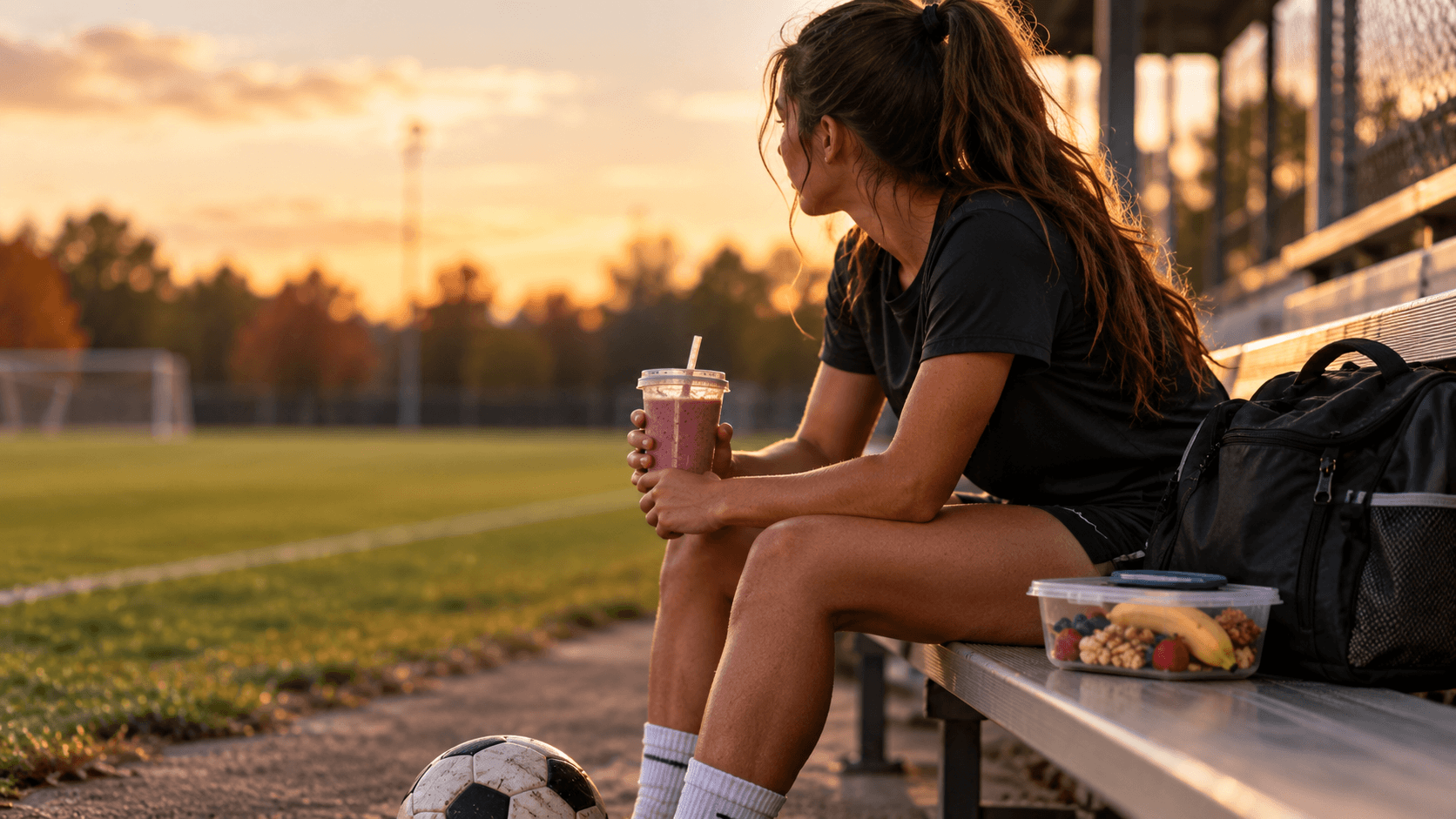
How Should Female Athletes Eat Through Their Menstrual Cycle?
Your app says you're in your luteal phase, the week or two before your period. A video you scrolled past last night says to cut carbs and skip hard training until your period starts. You've got a match on Saturday.
So what do you actually do?
If you track your cycle, you're already ahead. Most of the players I work with in elite environments track theirs, and it's a smart habit. The confusing part is what to do with the information, because a lot of what's online about eating by phase goes further than the research does.
My short answer: fuel enough every day first, because that takes care of most of the difference between phases. On top of that foundation, a few small shifts by phase are worth knowing, and this post walks through each one.
Does Your Menstrual Cycle Affect Athletic Performance?
On average, it's not enough to overly stress about but when trying to maximize performance there are some factors to be mindful of. In adult women, performance changed only slightly from phase to phase, with the lowest point in the first few days of the period, so there's no one-size rule that fits everyone [1].
Small differences like that might matter more at the elite level, where winning and losing are that close [1]. That's how I think about it. For most athletes the phase isn't something to plan your whole week around and stress over, and some athletes feel their cycle a lot more than others. The goal is learning your own pattern.
Does Eating by Phase Work for Athletes?
Online, eating and training by phase is called cycle syncing. Almost none of the most popular TikTok videos on the trend mentioned any research [2]. That doesn't make tracking a bad idea. It means the rigid rules in those videos (cut carbs here, skip training there) are ahead of the definitive evidence. That said, it supports how female specific focused research is lacking overall but because of the relatively light research it's important to keep that in mind.
Tracking still has real value though. The UEFA consensus on cycle tracking in women's football says it's useful for spotting irregular cycles, managing symptoms and learning about your own body, and that it should always be voluntary [3]. All great things not to overlook.
In my experience, trackers aren't always accurate, but they're still useful. Treat the app as a starting point. What it's best at is getting you to pay attention and ask better questions.
The Foundation: Are You Eating Enough Every Day?
Fueling enough every day is the first thing I check with every athlete, before we adjust anything by phase. The mix of carbohydrate and fat the body burns at rest and during exercise looks overall relatively similar from phase to phase in adult women [4]. Under-fueling, on the other hand, hurts you in every phase.
It starts with understanding the cycle. The adjustments come after that, and they sit on top of fueling enough every day. If breakfast is getting skipped or the snack before training is missing, that's the first thing to fix, whatever phase you're in.
What to Eat in Each Phase of Your Cycle
Here's how I'd walk through a month. One note before you read it: these patterns depend on ovulating. If you're on hormonal birth control, or you're in the first few years after your first period and your cycles are still settling, go by how you feel rather than the calendar.
The first few days of your period (menstrual phase)
Keep eating the way you normally would. There's no phase where cutting back helps you play.
Soreness after a hard session tends to be highest in these first few days [5]. So give recovery a little more attention: a full meal with protein and carbs after hard training, plenty of fluids, and a solid night of sleep.
On days when period symptoms hit, elite footballers covered a little less high-speed running in training [6]. It was a small difference, and it was about symptoms, not the period itself. If your symptoms are rough enough to affect training, that's a conversation worth having with your doctor so you have a plan. From a symptoms and soreness perspective though, some antioxidant focus can be helpful here to aid in the management of it.
About a week after your period starts (mid-follicular phase)
On a normal day, your carb stores may run a little lower in this phase [7]. In trained female endurance athletes, three days of extra carbohydrate filled those stores back up, though it didn't directly make them any faster [7].
So if a match or tournament lands here, the night-before and morning-of carbs matter. Rice, pasta, potatoes, bread, a bagel on game morning. Game days start the night before.
Ovulation (about two weeks before your next period)
Nothing special to eat here. Keep the foundation going. If you're tracking, this is a good time to jot down how training feels so you can compare it across a few months.
The week or two before your period (luteal phase)
This is the phase people ask me about most. A lot of athletes feel hungrier now, and the body may need a little more to balance out a slight increased caloric burn [8][9]. Not everyone notices it, and some work has found no change in appetite at all [10], so everybody's a little different.
If you do get hungrier, plan an extra snack into those days instead of fighting it. Yogurt with granola, a PB&J, or a bagel with peanut butter before training all work. Some additional protein with these snacks can help balance out a slight increase in protein breakdown alongside that increased energy need.
In elite environments, I see a few ways players who know where they are in their cycle adjust. The smoothie station is one that works especially well, because it meets each player's needs in one place: a little more carbohydrate, a little more protein, or more antioxidant-rich ingredients, depending on the phase. At home that can be as simple as milk or yogurt, oats, a banana and some berries.
One more luteal note for warm-weather tournaments: your body temperature runs a little higher in this phase [11]. It's a small shift, and in trained athletes it tends to be even smaller. In trained cyclists and triathletes, performance in the heat didn't change by phase [12]. On hot, humid days, it's just one more reason to start hydrated and stick to your heat plan.
What If You're on Hormonal Birth Control?
If you're on the pill, the phase advice above may not be as relevant to you. Hormonal birth control replaces your natural hormone pattern, so the phases don't map the same way.
The bigger point is what the monthly bleed can and can't tell you. On the pill, that bleed is your body reacting to the break in hormones, so it isn't a true period. That means it can hide a problem with your cycle, and it can also make it look like everything is fine when it isn't. Sports medicine experts warn that the pill can mask cycle changes caused by under-fueling [13].
So if you're on the pill, don't use the bleed as your fueling signal. Your energy, your recovery and how training feels tell you more. Any decisions about your birth control are for you and your doctor.
When Should a Missed or Irregular Period Worry You?
If your period stops, gets far apart or changes a lot, especially during heavy training, that's worth a doctor's look. Your period is information. Under-fueling is one of the first things to check, but it isn't the only possible cause, and in the first few years after your first period, cycles can simply take time to settle [14][13].
Before the appointment, jot down when your last few periods started and what training looked like around them. That gives your doctor something real to work with.
The encouraging part: eating more works for many athletes. Exercising women with missed or irregular periods who ate a bit more were about twice as likely to get their period back, though it took time, and a period coming back didn't mean everything had fully recovered [15][16]. Keep your doctor in the loop the whole way.
Where to Start
You don't need to overhaul anything. Two easy places to start:
1. Write down when your last three periods started. It shows you your own pattern and makes any change easier to spot.
2. Plan one extra snack for the week before your next period, if that's when you get hungrier.
You're already doing the hard part with the training. Fuel what you're asking your body to do. The examples here lean on soccer, and the same approach works for athletes in every sport, from track and swimming to basketball and volleyball.
-----------
Frequently Asked Questions
Does cycle syncing actually work for athletes?
Partly. Cycle syncing means eating and training by phase, and while parts of it line up with real physiology, the rigid rules are a little ahead of the clear definitive evidence. On average, the phase you're in changes performance subtly [1], and the mix of carbs and fat your body burns looks about the same across phases [4]. What holds up is fueling enough every day, then making small adjustments by phase and by how you feel.
Should I eat more before my period?
If you feel hungrier in the week or two before your period, yes, plan for it. Many women eat a little more in the luteal phase, and the body may need a little more as some do experience and increase in metabolism [8][9], though not everyone sees a change [10]. That pattern depends on ovulating, so on birth control or with irregular cycles, go by how you feel.
Does any of this apply if I'm on birth control?
Mostly not in the same way. Hormonal birth control replaces your natural hormone pattern, and the monthly bleed on the pill isn't a true period, so it can't tell you whether you're fueling enough [13]. Go by your energy, recovery and how training feels, and talk with your doctor about anything specific to your birth control.
Is it normal to miss a period during a hard season?
It happens but doesn't mean it SHOULD happen. Ist isn't something to push through or ignore. A missed or irregular period can be a sign of under-fueling, among other causes, so it's worth a doctor's look [14][13]. When athletes eat more, periods often come back, and it takes time [15].
Can a sports dietitian help me fuel around my cycle?
Yes. Rise Nutrition works virtually with competitive athletes in soccer and every other sport. On a free 15-minute Discovery Call, we look at where your fueling stands right now and what to work on first.
-----------
If you're tracking your cycle and still not sure what to do with it, the free 15-minute Discovery Call looks at your training, your cycle and how you're eating, and how Rise might be able to assist with optimizing your cycle. Book Your Discovery Call
Jay Short, MS, RD, CSSD is a Registered Dietitian and Board Certified Specialist in Sports Dietetics, and co-owner of Rise Nutrition, specializing in sports dietetics for competitive athletes. He works with US Soccer (all 27 teams), the Columbus Blue Jackets (NHL), and athletes across MLS, collegiate, and club programs.
-----------
References
1. McNulty KL, Elliott-Sale KJ, Dolan E, Swinton PA, Ansdell P, Goodall S, Thomas K, Hicks KM. The Effects of Menstrual Cycle Phase on Exercise Performance in Eumenorrheic Women: A Systematic Review and Meta-Analysis. Sports Med, 2020. [https://pubmed.ncbi.nlm.nih.gov/32661839/](https://pubmed.ncbi.nlm.nih.gov/32661839/)
2. Pfender E, Wanzer C, Mikkers L, Bleakley A. Sync or Swim: Navigating the Tides of Menstrual Cycle Messaging on TikTok. Perspect Sex Reprod Health, 2025. [https://pubmed.ncbi.nlm.nih.gov/40091514/](https://pubmed.ncbi.nlm.nih.gov/40091514/)
3. Verhagen E, Ferrer E, Antero JDS, et al. UEFA consensus statement on menstrual cycle tracking in women's football. BMJ Open Sport Exerc Med, 2025. [https://pubmed.ncbi.nlm.nih.gov/41001255/](https://pubmed.ncbi.nlm.nih.gov/41001255/)
4. D'Souza AC, Wageh M, Williams JS, et al. Menstrual cycle hormones and oral contraceptives: a multimethod systems physiology-based review of their impact on key aspects of female physiology. J Appl Physiol, 2023. [https://pubmed.ncbi.nlm.nih.gov/37823207/](https://pubmed.ncbi.nlm.nih.gov/37823207/)
5. Romero-Parra N, Cupeiro R, Alfaro-Magallanes VM, et al. Exercise-Induced Muscle Damage During the Menstrual Cycle: A Systematic Review and Meta-Analysis. J Strength Cond Res, 2021. [https://pubmed.ncbi.nlm.nih.gov/33201156/](https://pubmed.ncbi.nlm.nih.gov/33201156/)
6. Badier N, Dupuit M, Chassard T, et al. Menstrual cycle or hormonal contraceptive related symptoms in elite female athletes from retrospective self-questionnaires and daily monitoring: impact on well-being and objective performance metrics. Front Sports Act Living, 2025. [https://pubmed.ncbi.nlm.nih.gov/41378172/](https://pubmed.ncbi.nlm.nih.gov/41378172/)
7. McLay RT, Thomson CD, Williams SM, Rehrer NJ. Carbohydrate loading and female endurance athletes: effect of menstrual-cycle phase. Int J Sport Nutr Exerc Metab, 2007. [https://pubmed.ncbi.nlm.nih.gov/17507743/](https://pubmed.ncbi.nlm.nih.gov/17507743/)
8. Hurtová A, Gimunová M, Beníčková M. Resting metabolic rate fluctuations across the menstrual cycle: a systematic review. Front Physiol, 2026. [https://pubmed.ncbi.nlm.nih.gov/41971666/](https://pubmed.ncbi.nlm.nih.gov/41971666/)
9. Tucker JAL, McCarthy SF, Bornath DPD, Khoja JS, Hazell TJ. The Effect of the Menstrual Cycle on Energy Intake: A Systematic Review and Meta-analysis. Nutr Rev, 2025. [https://pubmed.ncbi.nlm.nih.gov/39008822/](https://pubmed.ncbi.nlm.nih.gov/39008822/)
10. Smith M, Aghayan M, Little J, Prior JC, Cohen TR, Soon Z, Bomide H, Purcell S. Energy intake and appetite in laboratory and free-living conditions may be consistent across menstrual cycle phases. Appetite, 2025. [https://pubmed.ncbi.nlm.nih.gov/41005066/](https://pubmed.ncbi.nlm.nih.gov/41005066/)
11. Giersch GEW, Morrissey MC, Katch RK, et al. Menstrual cycle and thermoregulation during exercise in the heat: A systematic review and meta-analysis. J Sci Med Sport, 2020. [https://pubmed.ncbi.nlm.nih.gov/32499153/](https://pubmed.ncbi.nlm.nih.gov/32499153/)
12. Lei TH, Stannard SR, Perry BG, Schlader ZJ, Cotter JD, Mündel T. Influence of menstrual phase and arid vs. humid heat stress on autonomic and behavioural thermoregulation during exercise in trained but unacclimated women. J Physiol, 2017. [https://pubmed.ncbi.nlm.nih.gov/27900769/](https://pubmed.ncbi.nlm.nih.gov/27900769/)
13. Williams NI, De Souza MJ, Misra M, et al. 2025 Update to the Female Athlete Triad Coalition Consensus Statement Part 2: Clinical Guidelines for Screening, Diagnosis, Treatment, and Return to Play for Adolescents and Adults. Sports Med, 2026. [https://pubmed.ncbi.nlm.nih.gov/41474492/](https://pubmed.ncbi.nlm.nih.gov/41474492/)
14. Mountjoy M, Ackerman KE, Bailey DM, et al. 2023 International Olympic Committee's (IOC) consensus statement on Relative Energy Deficiency in Sport (REDs). Br J Sports Med, 2023. [https://pubmed.ncbi.nlm.nih.gov/37752011/](https://pubmed.ncbi.nlm.nih.gov/37752011/)
15. De Souza MJ, Mallinson RJ, Strock NCA, et al. Randomised controlled trial of the effects of increased energy intake on menstrual recovery in exercising women with menstrual disturbances: the 'REFUEL' study. Hum Reprod, 2021. [https://pubmed.ncbi.nlm.nih.gov/34164675/](https://pubmed.ncbi.nlm.nih.gov/34164675/)
16. Mallinson RJ, Williams NI, Ricker EA, Allaway HCM, De Souza MJ. Multiple eumenorrheic cycles are necessary to observe a significant increase in estrogen exposure and ovulation in exercising women with functional hypothalamic oligo/amenorrhea undergoing a nutritional intervention: Insights from the REFUEL study. PM R, 2025. [https://pubmed.ncbi.nlm.nih.gov/41099383/](https://pubmed.ncbi.nlm.nih.gov/41099383/)

Ready to Take Your Nutrition
to the Next Level?
Stop guessing and start getting results. Book a free discovery call
to find the right coaching program for your goals.