
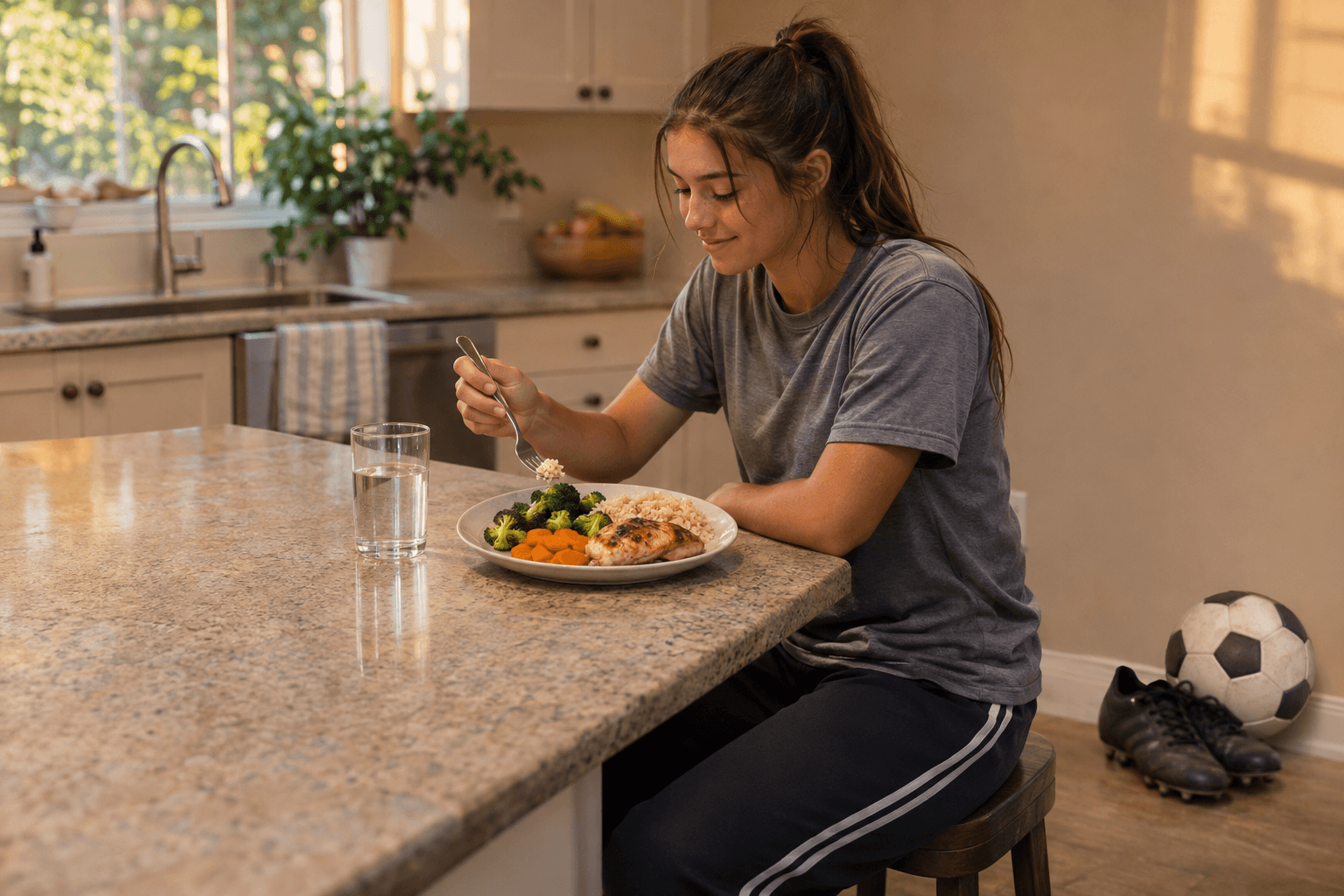
Your last game was a few days ago. There's no practice this week, no film, no bus ride. And somehow you're standing in the kitchen at 9 p.m., just as hungry as you were in the middle of the season.
That's what I see when a season ends. Training drops off a cliff, but the eating habits you built for game weeks keep running on autopilot: the same meal times and portions, and hunger that hasn't moved. Offseason nutrition for soccer players starts right there, with the gap between what your body is doing now and what your plate still thinks it's doing.
My short answer: in the offseason, eat for the day you're actually having. Keep regular meals going, let the carb portion come down a little on quiet days, bring it back up as offseason training starts, and skip the relax-now, cut-later cycle. The rest of this post walks through how.
Why Am I Still So Hungry After the Season Ended?
Because your appetite doesn't get the memo that the season ended. What I see when a season ends is the evidence that we all are creatures of habit. Players keep eating at the times and in the amounts that fueled their in-season schedule, and their hunger stays tuned to the work they were doing. The body takes a while to adjust to the lower demand.
A small study points in the same direction. When young men who weren't athletes became a little less active for a week and could eat freely, they kept eating the same amount and felt just as hungry [1]. That's a far smaller change than ending a season, and only a week, so it isn't proof that athletes work the same way. It does show why hunger alone won't tell you when to eat a little differently.
The takeaway: don't fight the hunger and don't ignore it. Give it a plan. That plan is what does the adjusting your appetite won't do on its own.
Is It Okay to Take Time Off After the Season?
Yes. A short break after a long season is fine, and it gives your body and your head a rest. How long you take is a conversation with your coach.
When adult male semi-pro soccer players took two weeks completely off after their season, their speed, strength and body composition didn't change [2]. Their endurance and their ability to repeat sprints did drop, and getting those back did take a little time [2]. Structured offseason programs help, though: across studies of male soccer players, they softened the drop in endurance and repeat sprints compared with stopping completely [3].
So the break isn't the enemy, and it isn't free either. What I see in practice is that strength you've built before comes back faster than it took to build the first time. Endurance is the slower one, as those players showed. A shorter break means less to win back. Rest on purpose, with a plan for the comeback.
What Should I Eat on Rest Days?
The same regular meals, with the plate sized to the day. It's simpler than it sounds.
Start by naming tomorrow. Before you think about food, look at what the day actually holds: a lift or hard conditioning, a skills session or pickup game, or a true rest day. Plan the day first, then build the plate.
Keep the meals. Every day gets breakfast, lunch and dinner, plus snacks when you're hungry. No skipping meals. No cutting out foods. Protein at every meal, fruit or vegetables on the plate, water through the day.
Let the carbs move. Carbs are the part of the plate that changes the most. Match what you eat, especially carbohydrate, to what each day actually asks of you [4].
Here's what that looks like in real life:
- Training day: a big share of rice, pasta, potatoes or bread, plus chicken, eggs, fish, beans or yogurt, plus vegetables or fruit.
- Quiet day: the same protein and the same color, with a little less rice or pasta. Still a full, normal dinner.
- The habit to watch: two plates of pasta made total sense the night before a game. On a Tuesday with no practice, maybe not.
None of this is a diet. It's lining your plate up with your week.
How Should I Eat When Offseason Training Starts?
Bring the plate back up with the work. The offseason has two halves, the break and the build, and the build is the one that's easy to under-fuel.
When lifting and conditioning come back, intake comes back up with them, and carbs climb the most. Guidelines written for pro players plan for both halves: eat to fit the drop when normal training stops, then bring intake back up once offseason training programs start [5]. The goal is to come back ready for preseason, not just lighter or heavier or whatever the scale says.
A simple check once your training picks up: are you still eating like it's your week off? If the lifts are back but the rice, pasta, oatmeal and fruit aren't, the plate is behind the work.
Should I Lose Weight Before Preseason?
Usually not, and a hard cut right before preseason is the version that costs you. What I see with some athletes is a two-step cycle: relax and let loose right after the season, then panic and cut hard as preseason gets close. The second half is where it really costs you.
The crash at the end is the costly part, especially if you're also trying to build muscle. In adults who lifted while eating too little, muscle gains stalled, though those studies were mostly in older adults who weren't athletes [6]. It shows though how it's difficult for the body to both build and lose at the same time. In elite athletes who needed to lose weight, the ones who did it slowly kept building muscle, and the ones who rushed it didn't [7]. Slow beats rushed.
If you're still growing, some weight gain is supposed to happen. For teen athletes it's fairly universally agreed to avoid severe or long restriction [4], and the American Academy of Pediatrics advises starting any weight change early enough to happen gradually, without a rollercoaster of weight going up and down [8].
So the steady version wins: regular meals all offseason, sized to each day, and nothing to crash-fix in February. If cutting has started to feel like it's taking over, that's worth talking to someone about and make sure to reach out to a trusted adult.
What If I Go Straight Into Another Sport?
Then you don't have an offseason yet, and that's fine. What I see is that many high school players don't get one. They go straight from a fall season into basketball, wrestling, hockey or club.
In that case, keep fueling like you're in season, because you are. Energy needs absolutely shift when you play more than one sport [4], so plan around the new practice and game schedule, not the old one. Something familiar before practice, carbs plus protein after, and a snack in the bag for late nights. Your real offseason comes later, whenever your last sport of the year wraps up.
Where to Start This Week
You don't need to overhaul anything. Two easy places to start:
1. Write out tomorrow before you plan your meals. Lift, skills, or rest? Build the plate to that.
2. Ask yourself one question at dinner: "Am I still eating like I have a game Saturday?"
You did the hard part all season. Now fuel what you're asking your body to do. The examples here lean on soccer, and the same approach works for athletes in every sport, from volleyball and cross country to football, basketball and swimming. Your offseason just lands at a different time of year.
-----------
Frequently Asked Questions
How long should athletes rest after the season?
A short break is fine, and the exact length is you and your coach's call. When adult male semi-pro soccer players took two weeks fully off, speed and strength held, while endurance and repeat sprints took about an equal amount of time as the break to win back [2]. Longer breaks weren't tested, so plan the comeback before you need it.
Do I need to eat less in the offseason?
Not across the board. On quiet days the carb portion can come down a little, while every meal and your protein stay. Pro guidelines say to bring the carbs back up when offseason training starts [5].
Should I bulk up in the offseason?
Not by eating as much as you can. In adult lifters, gaining weight faster mostly added fat rather than strength [9]. Fuel your training well, and let the lifting and steady meals do the building.
Is it normal for teen athletes to gain weight in the offseason?
Yes, if you're still growing, some weight gain is expected [4]. That's growth, not a problem to fix. If your weight does need to change, start early and go slowly, and avoid crash dieting before tryouts [8].
Can a sports dietitian help me plan my offseason?
Yes. Rise Nutrition works virtually with competitive athletes in soccer and every other sport. On a free 15-minute Discovery Call, we look at what your offseason actually looks like and build the plate around it, from the break through preseason.
-----------
If you're not sure what your offseason should look like, from fueling the break to building into preseason, that's what the free 15-minute Discovery Call is for. Book Your Discovery Call
Jay Short, MS, RD, CSSD is a Registered Dietitian and Board Certified Specialist in Sports Dietetics, and co-owner of Rise Nutrition, specializing in sports dietetics for competitive athletes. He works with US Soccer (all 27 teams), the Columbus Blue Jackets (NHL), and athletes across MLS, collegiate, and club programs.
-----------
References
1. Stubbs RJ, Hughes DA, Johnstone AM, Horgan GW, King N, Blundell JE. A decrease in physical activity affects appetite, energy, and nutrient balance in lean men feeding ad libitum. American Journal of Clinical Nutrition, 2004. [https://pubmed.ncbi.nlm.nih.gov/14684398/](https://pubmed.ncbi.nlm.nih.gov/14684398/)
2. Joo CH. The effects of short term detraining and retraining on physical fitness in elite soccer players. PLoS One, 2018. [https://pubmed.ncbi.nlm.nih.gov/29746505/](https://pubmed.ncbi.nlm.nih.gov/29746505/)
3. Clemente FM, Ramirez-Campillo R, Sarmento H. Detrimental Effects of the Off-Season in Soccer Players: A Systematic Review and Meta-analysis. Sports Medicine, 2021. [https://pubmed.ncbi.nlm.nih.gov/33400214/](https://pubmed.ncbi.nlm.nih.gov/33400214/)
4. Desbrow B, McCormack J, Burke LM, et al. Sports Dietitians Australia position statement: sports nutrition for the adolescent athlete. International Journal of Sport Nutrition and Exercise Metabolism, 2014. [https://pubmed.ncbi.nlm.nih.gov/24668620/](https://pubmed.ncbi.nlm.nih.gov/24668620/)
5. Collins J, Maughan RJ, Gleeson M, et al. UEFA expert group statement on nutrition in elite football. Current evidence to inform practical recommendations and guide future research. British Journal of Sports Medicine, 2021. [https://pubmed.ncbi.nlm.nih.gov/33097528/](https://pubmed.ncbi.nlm.nih.gov/33097528/)
6. Murphy C, Koehler K. Energy deficiency impairs resistance training gains in lean mass but not strength: A meta-analysis and meta-regression. Scandinavian Journal of Medicine and Science in Sports, 2022. [https://pubmed.ncbi.nlm.nih.gov/34623696/](https://pubmed.ncbi.nlm.nih.gov/34623696/)
7. Garthe I, Raastad T, Refsnes PE, Koivisto A, Sundgot-Borgen J. Effect of two different weight-loss rates on body composition and strength and power-related performance in elite athletes. International Journal of Sport Nutrition and Exercise Metabolism, 2011. [https://pubmed.ncbi.nlm.nih.gov/21558571/](https://pubmed.ncbi.nlm.nih.gov/21558571/)
8. Carl RL, Johnson MD, Martin TJ; Council on Sports Medicine and Fitness. Promotion of Healthy Weight-Control Practices in Young Athletes. Pediatrics, 2017. [https://pubmed.ncbi.nlm.nih.gov/28827381/](https://pubmed.ncbi.nlm.nih.gov/28827381/)
9. Helms ER, Spence AJ, Sousa C, Kreiger J, Taylor S, Oranchuk DJ, Dieter BP, Watkins CM. Effect of Small and Large Energy Surpluses on Strength, Muscle, and Skinfold Thickness in Resistance-Trained Individuals: A Parallel Groups Design. Sports Medicine Open, 2023. [https://pubmed.ncbi.nlm.nih.gov/37914977/](https://pubmed.ncbi.nlm.nih.gov/37914977/)

Ready to Take Your Nutrition
to the Next Level?
Stop guessing and start getting results. Book a free discovery call
to find the right coaching program for your goals.