
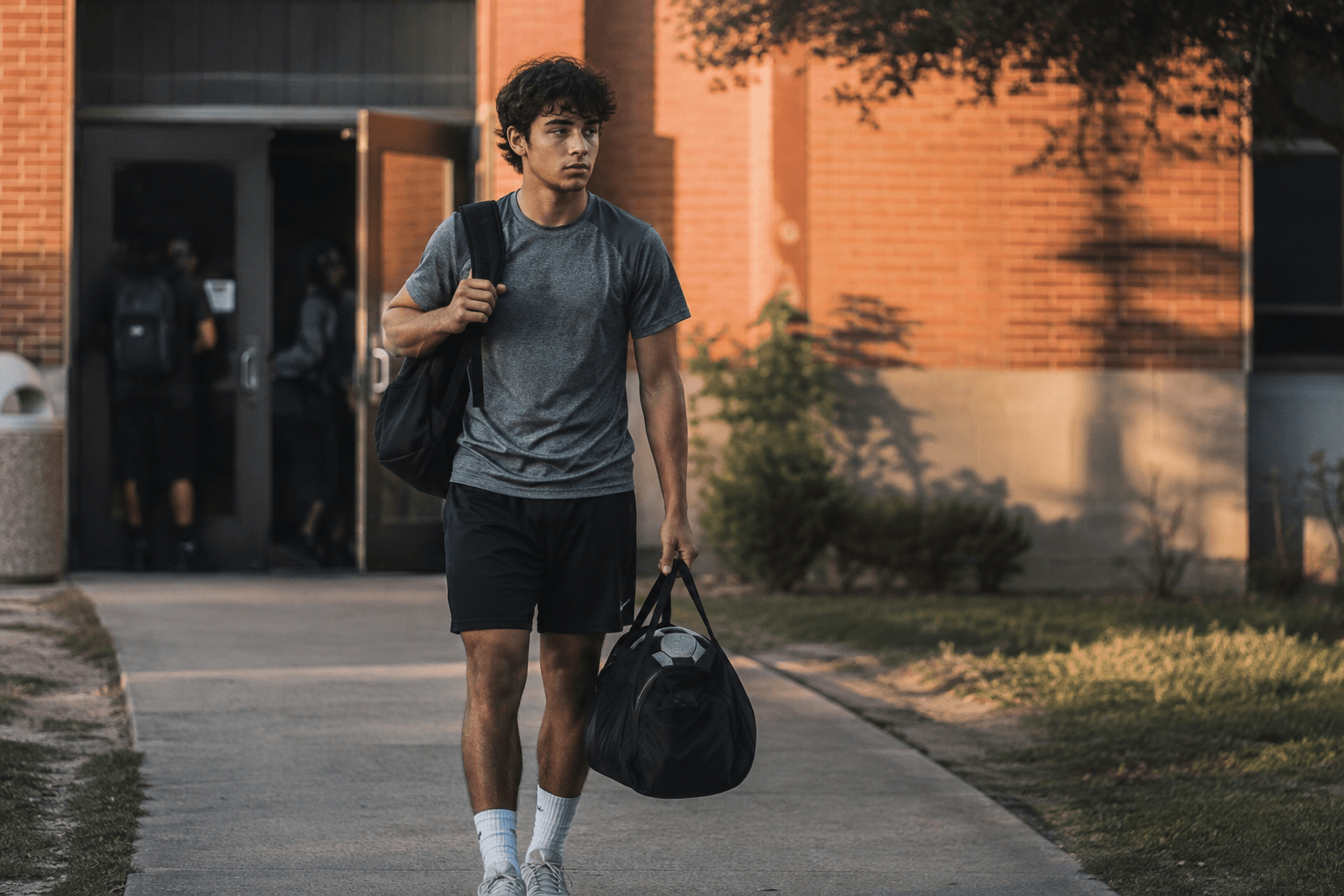
The School-Day Fueling Gap: Why Your Athlete Runs Out Before Practice Ends
Your athlete ate lunch at 10:45 this morning. Practice starts at 3:30. Sitting in the middle of that is nearly five hours with nothing in it, and that time ends at the start of the hardest physical work of their day.
That gap opened this week. School just started, and the eating rhythm that held together all summer got replaced by a schedule nobody designed with a competitive athlete in mind.
If you have been watching your player fade in the last twenty minutes of practice, or hearing that they felt flat at a 5:00 kickoff, this is worth reading before you add another conditioning session. The pattern usually has a cause, and it is often sitting on the clock rather than in their fitness.
The gap nobody planned
Run the actual day. Alarm at 6:15. Breakfast around 6:45, if it happens at all. Lunch period somewhere near 10:45 in the morning. Then nothing until practice at 3:30, or a 5:00 kickoff, which pushes the gap past six hours.
Nobody built that schedule to be hostile. It is a school moving a few thousand students through a cafeteria, and it produces a midday meal closer to breakfast than to lunch.
The lunch period itself is worth a closer look. The CDC recommends a lunch period of about 30 minutes, with at least 20 of those minutes spent seated and actually eating, and it notes that roughly half of US school districts do not require or recommend that 20-minute minimum. Once you subtract the walk from class, the line, and the walk back, a 22-minute period leaves very little seated time.
So the athlete is being asked to fit their largest daytime meal into a window that was not designed for eating, at an hour that is not designed for hunger, and then wait five hours before the work starts.
Why timing beats total
Here is where most conversations about this go sideways. A parent says the athlete eats plenty, and that is usually true. Total intake was never the variable doing the damage.
Researchers have tested this directly. In a randomized crossover trial published in the European Journal of Sport Science, trained cyclists completed two identical days. Same total energy, same total carbohydrate, same everything, with one difference: on one day the morning meal was moved and everything was eaten at lunch instead. Evening time-trial power came in about 3% lower on that non-breakfast day, a drop of 9.1 watts. Blood glucose, heart rate, and lactate showed no differences at all. The authors concluded the decreased power was related to meal timing rather than to carbohydrate intake.
A separate trial in Medicine and Science in Sports and Exercise pushed the question harder. Participants skipped breakfast and then ate nearly 200 more calories at lunch to make up for it. Nine hours later they still produced 4.5% less work in an evening performance test.
And a 2022 study in the International Journal of Sport Nutrition and Exercise Metabolism looked at something closer to the school day itself. Participants ate both breakfast and lunch, then waited seven hours before an evening session. Performance came in 3.8% lower, but the more useful finding was what happened before they started: motivation, energy, and readiness were all measurably lower.
That last part matters more than the percentage. Low readiness before a session is exactly what gets read from the sideline as a kid who is not trying.
What the gap actually costs on the field
Soccer is a demanding sport and is very difficult to play on a low tank, with good data to show why.
In a study of competitive match play published in Medicine and Science in Sports and Exercise, muscle glycogen fell from 449 to 255 millimoles per kilogram of dry weight across a game, and 47% of individual muscle fibers were completely or almost empty by full time. That is what ninety minutes asks for when a player starts full.
Start lower than that and the cost shows up in a specific place. Research in the International Journal of Sports Medicine compared players across a 90-minute game after high and low carbohydrate preparation and found roughly 33% more high-intensity running was done when they started with more fuel on board.
Now the part most nutrition content leaves out. That same study measured technical performance and found no significant difference in any of it. Touch, passing, and the skill side held up.
Worth being straight about, because it is the honest version. Underfueling does not appear to take away what your athlete can do with the ball. It takes away how much of it they can do, and it takes it away late. First step, recovery runs, and the last fifteen minutes.
One correction while we are here. This is not a blood sugar crash. Glucose stayed elevated through the match above, and the meal-timing trial found no glucose difference at all despite a real performance drop. The mechanism is fuel availability when the work starts.
The three eating occasions that decide the day
You cannot move the lunch bell and you cannot move practice. Three things are genuinely yours.
Breakfast is the one you fully control
The school sets lunch. The coach sets practice. Breakfast is the only occasion your athlete can move without asking anyone's permission, which makes it the highest-leverage meal in the day even though it is the furthest from the session.
It is also, in the research, the thinnest one. A study in the International Journal of Sport Nutrition and Exercise Metabolism tracked seven days of food diaries in academy players at an English Premier League club and found protein intake skewed across every age group, with breakfast running at roughly half what those players ate at dinner. The same study concluded the players were not meeting carbohydrate guidelines overall.
Worth noting what does not work as a shortcut. In schoolchildren tested across a morning, a glucose drink performed no better than skipping breakfast, while a cereal breakfast reduced the decline in attention and memory. Something sugary on the way out the door is closer to nothing than to a complete breakfast but something is always better than nothing.
Let lunch stay a real meal
Lunch is compressed and badly timed, and it is still the biggest thing standing between the morning and practice. The most common way it quietly gets worse is a bar replacing it.
A protein bar does the protein job but it does not do the fuel job. Alongside lunch it is useful. In place of lunch, it trades away the key energy that the one midday meal should offer, and by four o'clock the tank is even lower than it was before practice even starts.
Protein is not what an athlete runs out of at the end of practice.
The window between last bell and warmups
This is the occasion nobody plans, and it sits closest to the work.
Typically the pre-match fueling window is ideally three to four hours before the game. A 10:45 lunch does not fall inside it for a 3:30 practice, and it is nowhere near it for a 5:00 kickoff. Which means whatever gets eaten between last bell and warmups is not just a snack squeezed in around the edges. On a school day, that is functionally the pre-game meal, and it deserves the same thought you would give a meal three hours before a match.
The two reasons this falls apart in real life
"I'm not hungry that early"
This is the objection I hear more than any other, and it is worth taking seriously rather than arguing with.
What I see over and over is a body that has stopped asking. Feed it in the morning and it starts asking again, usually within a couple of weeks. Go long enough without and the signal goes quiet, because the body adapted to a pattern where nothing arrives. A quiet hunger signal is not the same as not needing fuel.
This is a clinical observation from working with athletes rather than a research finding, and I would rather label it that way than dress it up. The practical version is simple. Start smaller than feels worth doing, keep the time fixed, and let the signal come back on its own.
"My school doesn't allow it"
Plenty of schools do not permit food in classrooms or hallways. That is a real constraint, not an excuse, and pretending otherwise is how nutrition advice gets ignored.
So we work the windows that actually exist: A passing period, the ride to the field, the stretch between last bell and warmups. Something shelf-stable that lives permanently in the bag beats anything that requires a decision at 6:30 in the morning.
What the gap does to the rest of the school day
There is a second argument here that has nothing to do with sport, and parents tend to feel this one first.
In a randomized crossover trial in Physiology and Behavior, 96 adolescents aged 12 to 15 completed the same morning twice, once having eaten breakfast and once having skipped it. Accuracy and response times were better on the breakfast days, and the detail worth holding onto is where the benefit showed up: later in the morning, and on the harder tasks. The cost of the gap accrues rather than appearing at the moment of the missed meal.
A systematic review of 45 studies in Advances in Nutrition found breakfast reliably supported attention, executive function, and memory relative to fasting. That review also notes effects were most apparent in undernourished children, which is the ceiling on this argument for a well-fed athlete.
The population-level picture comes from the CDC. In the 2023 Youth Risk Behavior Survey of 20,103 US high school students, 72.6% had missed breakfast at least once in the previous week and 17.9% skipped it every single day. Students earning mostly A's and B's were 35% less likely to be daily breakfast skippers. That is an association from a cross-sectional survey rather than proof that breakfast raises grades, and the direction could plausibly run the other way. It is still worth knowing how common this is.
Now the part I would rather concede than overstate. The evidence about the morning is strong. The evidence about the midday meal specifically is not. Controlled trials that manipulated lunch in this age group have found essentially nothing for afternoon cognition. So if someone tells you an early lunch period is costing your athlete their afternoon classes, that claim is running ahead of the research. The morning is where the school-performance argument holds.
Fluid is running behind too
The same schedule problem shows up in hydration, and it starts earlier than most people expect.
In a study of 59 elite young athletes averaging just over 15 years old, published in the Journal of Strength and Conditioning Research, more than 89% were dehydrated on their first morning urine sample and 76.3% were still dehydrated when they arrived at training. They did not fall behind during the session. They were showing up that way, and the day never gave them a chance to catch up.
Whatever routine fixes the food timing can carry the water bottle along with it.
Where to start this week
Not all of it, just one thing.
Most athletes try to fix breakfast, lunch, and the afternoon simultaneously on a Monday, hold it until Wednesday, and conclude they are bad at this. They are not bad at it, they just took on three changes during the first week of school.
So pick the barrier that is actually in the way, because these are different problems with different fixes. Not being hungry in the morning is a hunger-signal problem. No time at lunch is a logistics problem. Not being allowed to eat in class is a storage problem.
Change one. Hold it for seven days. Leave everything else alone long enough to see what it did.
-----------
Frequently Asked Questions
What should a high school athlete eat between school and practice?
Something real, and sooner rather than perfect. Carbohydrate they have eaten before training already, something familiar that sits well, and enough of it to be worth eating. The window between last bell and warmups is functionally the pre-training meal on a school day, so it deserves more thought than a handful of whatever is in the bag.
My athlete says they are not hungry in the morning. Should I push it?
Push the timing rather than the volume. Start with something small and familiar at the same time each morning and give it a week or two. Appetite signals track the pattern they have been taught, and a quiet signal usually gets louder once food starts arriving regularly again. Forcing a large breakfast on day one tends to backfire.
What should a soccer player eat after a game?
Carbohydrate and some protein reasonably soon after the final whistle, especially with another session or match inside 24 hours. On a school night, when a game finishes late and the alarm is still set for 6:15, that meal matters more than usual because the overnight window is short.
Does a protein bar count as lunch?
Alongside lunch, a bar can be useful. Instead of lunch, it is a trade that costs you. The bar handles protein and leaves the fuel side of the meal unfilled (the carbs), which is the part that determines how the last twenty minutes of practice go.
How do I know whether my athlete actually needs help with this, or if we can sort it ourselves?
Most families can fix this themselves with one change held for a week. It is worth a conversation when the pattern repeats despite genuine effort, or when you are not sure which of the three barriers you are dealing with. That is what a free 15-minute Discovery Call is for: mapping the specific week rather than the general principle.
-----------
If your athlete's afternoon keeps falling apart and you would rather map this around their actual schedule than guess at it, I offer a free 15-minute Discovery Call where we can discuss how we could navigate that: Book Your Discovery Call
Jay Short, MS, RD, CSSD is a Registered Dietitian and Board Certified Specialist in Sports Dietetics, and co-owner of Rise Nutrition, specializing in sports dietetics for competitive athletes. He works with US Soccer (all 27 teams), the Columbus Blue Jackets (NHL), and athletes across MLS, collegiate, and club programs.
-----------
References
1. Metcalfe RS, Thomas M, Lamb C, Chowdhury EA. Omission of a carbohydrate-rich breakfast impairs evening endurance exercise performance despite complete dietary compensation at lunch. [https://pubmed.ncbi.nlm.nih.gov/32674691/](https://pubmed.ncbi.nlm.nih.gov/32674691/)
2. Clayton DJ, Barutcu A, Machin C, Stensel DJ, James LJ. Effect of Breakfast Omission on Energy Intake and Evening Exercise Performance. [https://pubmed.ncbi.nlm.nih.gov/25970668/](https://pubmed.ncbi.nlm.nih.gov/25970668/)
3. Slater T, Mode WJA, Pinkney MG, Hough J, James RM, Sale C, James LJ, Clayton DJ. Fasting Before Evening Exercise Reduces Net Energy Intake and Increases Fat Oxidation, but Impairs Performance in Healthy Males and Females. [https://pubmed.ncbi.nlm.nih.gov/36170970/](https://pubmed.ncbi.nlm.nih.gov/36170970/)
4. Krustrup P, Mohr M, Steensberg A, Bencke J, Kjaer M, Bangsbo J. Muscle and blood metabolites during a soccer game: implications for sprint performance. [https://pubmed.ncbi.nlm.nih.gov/16775559/](https://pubmed.ncbi.nlm.nih.gov/16775559/)
5. Balsom PD, Wood K, Olsson P, Ekblom B. Carbohydrate intake and multiple sprint sports: with special reference to football (soccer). [https://pubmed.ncbi.nlm.nih.gov/10090462/](https://pubmed.ncbi.nlm.nih.gov/10090462/)
6. Naughton RJ, Drust B, O'Boyle A, Morgans R, Abayomi J, Davies IG, Morton JP, Mahon E. Daily Distribution of Carbohydrate, Protein and Fat Intake in Elite Youth Academy Soccer Players Over a 7-Day Training Period. [https://pubmed.ncbi.nlm.nih.gov/27633998/](https://pubmed.ncbi.nlm.nih.gov/27633998/)
7. Burke LM, Hawley JA, Wong SHS, Jeukendrup AE. Carbohydrates for training and competition. [https://pubmed.ncbi.nlm.nih.gov/21660838/](https://pubmed.ncbi.nlm.nih.gov/21660838/)
8. Arnaoutis G, Kavouras SA, Angelopoulou A, Skoulariki C, Bismpikou S, Mourtakos S, Sidossis LS. Fluid Balance During Training in Elite Young Athletes of Different Sports. [https://pubmed.ncbi.nlm.nih.gov/24513625/](https://pubmed.ncbi.nlm.nih.gov/24513625/)
9. Cooper SB, Bandelow S, Nevill ME. Breakfast consumption and cognitive function in adolescent schoolchildren. [https://pubmed.ncbi.nlm.nih.gov/21439306/](https://pubmed.ncbi.nlm.nih.gov/21439306/)
10. Adolphus K, Lawton CL, Champ CL, Dye L. The Effects of Breakfast and Breakfast Composition on Cognition in Children and Adolescents: A Systematic Review. [https://pubmed.ncbi.nlm.nih.gov/27184287/](https://pubmed.ncbi.nlm.nih.gov/27184287/)
11. Wesnes KA, Pincock C, Richardson D, Helm G, Hails S. Breakfast reduces declines in attention and memory over the morning in schoolchildren. [https://pubmed.ncbi.nlm.nih.gov/14637332/](https://pubmed.ncbi.nlm.nih.gov/14637332/)
12. Sliwa SA, Merlo CL, McKinnon II, Self JL, Kissler CJ, Saelee R, Rasberry CN. Skipping Breakfast and Academic Grades, Persistent Feelings of Sadness or Hopelessness, and School Connectedness Among High School Students, Youth Risk Behavior Survey, United States, 2023. [https://pubmed.ncbi.nlm.nih.gov/39378262/](https://pubmed.ncbi.nlm.nih.gov/39378262/)
13. Centers for Disease Control and Prevention. Time for Lunch: school nutrition guidance. [https://www.cdc.gov/school-nutrition/school-meals/time-for-lunch.html](https://www.cdc.gov/school-nutrition/school-meals/time-for-lunch.html)

Ready to Take Your Nutrition
to the Next Level?
Stop guessing and start getting results. Book a free discovery call
to find the right coaching program for your goals.