
Sleepmaxxing for Athletes: What Actually Helps After a Night Game
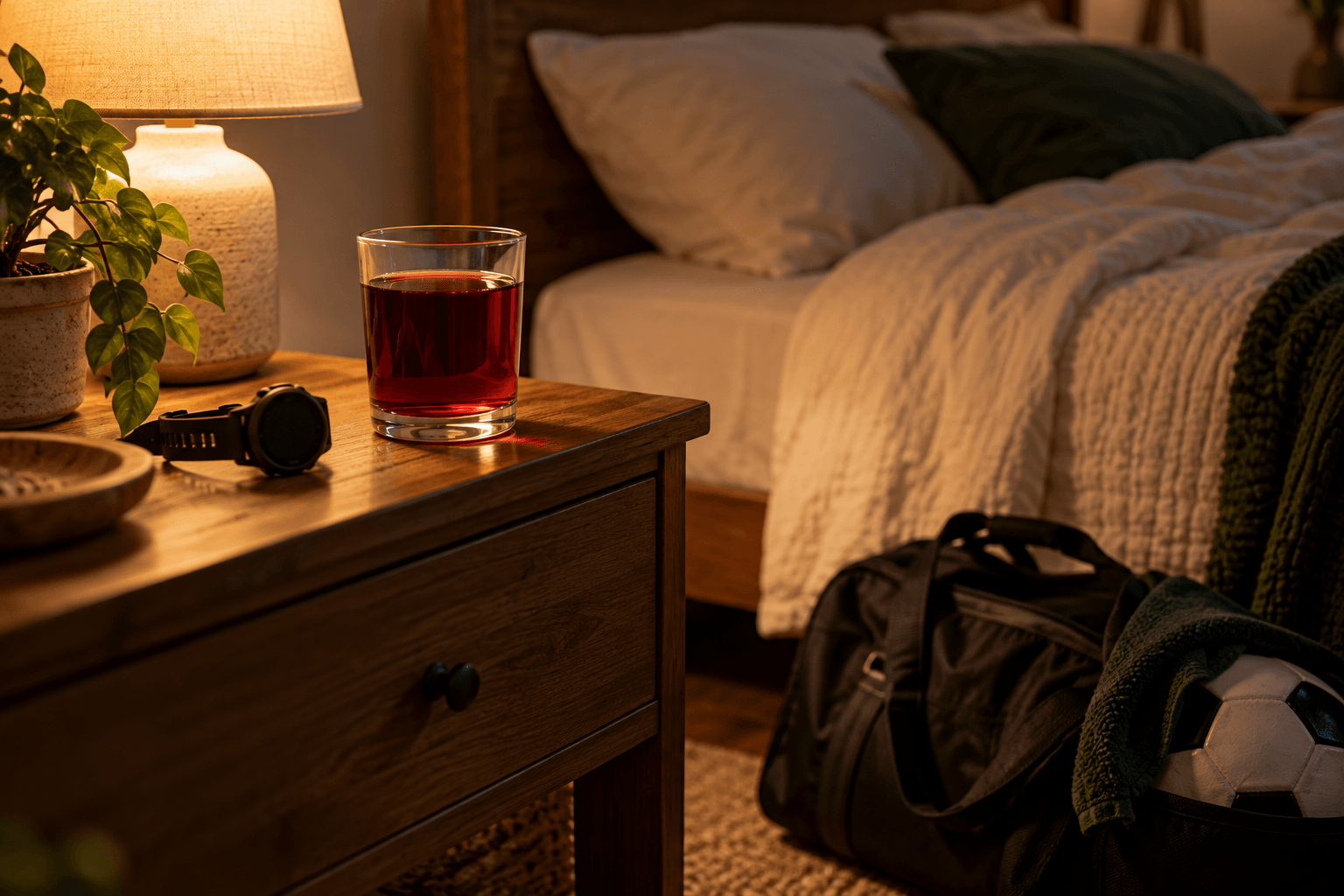
It's a night game. You get home at 10:30 with heavy legs and your head still replaying the second half. On the nightstand there's a melatonin gummy, maybe a magnesium capsule, a glass of tart cherry juice, a strip of mouth tape, and a watch that will hand you a sleep score in the morning.
That setup has a name online now: sleepmaxxing. The instinct behind it is a good one. You care about recovery, and a lot of recovery happens while you sleep.
With the athletes I work with, the biggest sleep gap usually isn't in the supplement drawer. It's in the kitchen. After late games, a lot of them go to bed having eaten very little, and nothing in their so-called sleepmaxxing stack touches that.
The short version: most of the stack has barely been tested in athletes. After a night game, a real meal and the sleep basics do the heavy lifting.
What Is Sleepmaxxing?
Sleepmaxxing is the social media trend of stacking products and habits to chase the best possible night of sleep. The usual stack contains a few things along the lines of melatonin gummies, magnesium, tart cherry juice (often mixed into a drink with a catchy name like the "sleepy girl mocktail"), mouth tape and a wearable that scores your night.
Does the Sleepmaxxing Stack Actually Work for Athletes?
For the most part, we don't know yet. Sports medicine experts who reviewed the evidence say there are very few high-quality studies on nutrition and athlete sleep, and they warn athletes to be wary of sleep-supplement claims that haven't been backed up [1]. Piece by piece:
- Melatonin gummies. Labels have been unpredictable. When 25 US gummy brands were tested, only 3 came close to what the label said. In the ones that had any melatonin, the amount ran from about three-quarters of the label to more than three times it, and one had none at all [2]. If you don't know the dose you're getting, that's a problem on its own, and it's one more reason melatonin shouldn't be taken lightly.
- Magnesium. One trial found a small improvement in how adults who already slept poorly rated their own insomnia, and the capsules also contained glycine, so magnesium can't take all the credit [3]. Nobody in it was an athlete. Food and the basics come first. The mechanism of magnesium though leaves the door open for real potential.
- Tart cherry juice. In one small study of college women's field hockey players, it cut the time spent awake during the night without changing how long they slept [4]. Interesting, and a long way from proven but does support that it doesn't hurt. As for the sleepy girl mocktail itself, I couldn't find a single study of the drink, which shouldn't come as a big surprise.
- Mouth tape. A review of the research found no studies in healthy people and flagged a potential for serious harm, especially when your nose is blocked [5]. I'd like to think the risk of having your mouth and nose blocked at the same time goes without saying, but they wanted to make sure! There's no 'statistically relevant' evidence it helps healthy athletes, and if you're worried about how you breathe at night, that's a conversation for your doctor.
- Sleep trackers. Six popular wrist trackers, tested in adults at a sleep clinic, all picked up sleep well and missed a lot of the time people were awake, and their deep sleep and other stage readings were only fair to moderate [6]. The technology keeps improving, so treat the numbers as a rough guide.
One more thing for competitive athletes: supplements that aren't third-party tested carry a doping risk [1]. That's one more reason anything in a bottle starts with a conversation with your doctor.
For parents: what pediatric sleep experts say about melatonin
Melatonin is the one part of the stack where the buying decision usually sits with a parent, so this part is written for you. The researchers who tested those gummies estimated that a child taking them as directed could get 40 to 130 times more melatonin than the tiny amount shown to raise young adults' levels into the normal nighttime range [2].
The American Academy of Pediatrics puts it plainly: melatonin "is NOT a sleeping pill" [7]. The International Pediatric Sleep Association says it "should still be considered a medication," shouldn't be used to make sleep better in kids who have no sleep complaint, and isn't meant for long-term use in most healthy children [8]. The American Academy of Sleep Medicine advises talking with a pediatric health care professional before starting melatonin or any other supplement [9]. If sleep is a real problem, start with your doctor.
Why Is Sleep So Hard After a Night Game?
Some of it is just the schedule. Evening training and matches are commonly linked with falling asleep later and sleeping less [1], and in elite pro soccer players, total sleep after night matches ran about an hour and a half shorter than after training days [10]. A short night after a late kickoff is normal, and a gummy won't change the kickoff time.
Fuel may be part of it too. In teenage rugby players, the ones who ate the least compared with their training slept worse on the last night of a hard training week, with more time awake and less deep sleep [11]. That's a link, and those players differed in other ways too.
It does match what I see after evening games. Players get home late, some eat very little, and they head to bed wired. The recovery meal is the part of that night they control, and it shouldn't be overlooked.
Is It Bad to Eat Before Bed After a Night Game?
The research we have in athletes hasn't shown that a meal close to bedtime hurts their sleep.
In elite pro Australian football players, eating closer to bedtime showed slightly longer sleep and a little more waking during the night, and bigger evening meals went with taking a few minutes longer to fall asleep [12]. Across the wider research, studies that simply tracked people's habits mostly link late eating with worse sleep, while studies that actually tested a meal about 2 hours before bed in healthy adults or athletes found no harm, or even better sleep [13].
A very heavy plate right at lights-out can sit badly, so give a big meal a little time to settle when possible. In my experience, going to bed hungry after a game is the bigger worry. You just pushed your body hard, and it needs fuel to recover and refill the tank for tomorrow.
What Should You Eat Before Bed After a Game?
Start with a full meal, and make sure it has carbs and protein in it.
I generally recommend a little protein before bed. The way I explain it to athletes: overnight is when your body does a lot of its repair work from the day, and protein gives it the tools that it needs to work with.
Carbs refill the tank you just emptied. You'll see posts claiming fast-digesting carbs like white rice help you fall asleep faster. A couple of small studies in young men point that way [14][15], but one was built around a huge meal that's hard to copy at home, and a study of basketball players on the nights before games found no difference [16]. Choose the carbs you and enjoy and know that sit well with YOU for recovery.
Some easy options late at night: a turkey sandwich, eggs on toast, yogurt with fruit and granola, a bowl of cereal and milk, or leftover pasta with chicken. Go with whatever your stomach handles well.
If solid food doesn't sound good after a game, change the format. A smoothie often goes down easier than a plate, and it still counts.
Do the Sleep Basics Still Matter?
Yes. Like with most things, the basics do the most work. Sports medicine experts put the range at 8 to 10 hours for teenagers and 7 to 9 for adults, with room for an individual approach [1]. The habits are simple: a cool, dark, quiet room, morning light, a relaxing routine, not lying awake in bed for long stretches, and caffeine kept away from bedtime. Teenagers also tend to be night owls, because their melatonin is released later in the evening [1]. If you're a teenager who can't fall asleep early, that's partly biology, so lean on the habits above and go easy on yourself.
Your Night-Game Routine
Eating comes first, every time. Then pick one of the others and focus on one at a time.
- Eat a full meal. Don't overthink it or worry about eating too late. Your body needs the fuel, and you'll thank yourself the next day.
- Eat as soon as you can. The sooner you eat, the more time it has to settle before you lie down. If nothing's possible until you're home, eat when you walk in, then shower and wind down.
- Go liquid if food won't go down. A smoothie still counts.
- Add a little protein before bed.
- Keep the room cool, dark and quiet, with a short, simple routine before lights-out.
- Give the sleep score a rest on game days. A 10-minute drop can bother some players all morning. For them, it's best to skip the tracker the night before a game, or wait to check the score until after. Whatever it says, you're still going to compete, whether it's red, yellow or green.
-----------
Frequently Asked Questions
What is sleepmaxxing?
Sleepmaxxing is a social media trend of stacking products and habits for better sleep, usually melatonin gummies, magnesium, tart cherry juice, mouth tape and a sleep-tracking wearable. Most of these have barely been tested in athletes, and sports medicine experts advise athletes to be wary of sleep-supplement claims that haven't been backed up [1].
Is melatonin safe for teenage athletes?
Pediatric sleep experts say melatonin should be treated as a medication, used only with a doctor involved, and not used to make sleep better in teens who have no sleep complaint [8]. Gummy labels have been unreliable too: of 25 brands tested, only 3 came close to their label, and one had no melatonin at all [2]. Supplements that aren't third-party tested also carry a doping risk for competitive athletes [1].
Is it bad to eat before bed after a late game?
The research in athletes hasn't shown that a meal close to bedtime hurts sleep. In elite pro Australian football players, eating closer to bed went with slightly longer sleep and a little more waking during the night [12]. In my experience, going to bed hungry after a game is the bigger worry, because recovery runs on fuel. Eat as soon after the game as you can to give a very large plate a little extra time before lying down.
Are sleep trackers accurate for athletes?
Wrist trackers are good at picking up sleep and poor at picking up time awake. When six popular trackers were tested against a sleep lab in adults at a sleep clinic, all of them missed a lot of wake time, most overestimated total sleep, and stage readings were only fair to moderate [6]. They can add some insight, so take the numbers with a grain of salt and don't let one bad recovery score ruin your day.
Can a sports dietitian help an athlete who isn't sleeping well?
A sports dietitian can look at the fueling side, especially when poor sleep shows up after late games and heavy training weeks. Rise Nutrition works virtually with competitive athletes in soccer and every other sport, and on the free 15-minute Discovery Call we talk through the challenges you're facing and how we might work together. Anything medical, including sleep problems that don't improve, goes to your doctor.
-----------
If late games keep leaving you home at 10:30, starving and wired, the free 15-minute Discovery Call is where we can talk through what you're facing and how Rise can help. Book Your Discovery Call
Jay Short, MS, RD, CSSD is a Registered Dietitian and Board Certified Specialist in Sports Dietetics, and co-owner of Rise Nutrition, specializing in sports dietetics for competitive athletes. He works with US Soccer (all 27 teams), the Columbus Blue Jackets (NHL), and athletes across MLS, collegiate, and club programs.
-----------
References
1. Walsh NP, Halson SL, Sargent C, et al. Sleep and the athlete: narrative review and 2021 expert consensus recommendations. Br J Sports Med, 2021. [https://pubmed.ncbi.nlm.nih.gov/33144349/](https://pubmed.ncbi.nlm.nih.gov/33144349/)
2. Cohen PA, Avula B, Wang YH, Katragunta K, Khan I. Quantity of Melatonin and CBD in Melatonin Gummies Sold in the US. JAMA, 2023. [https://pubmed.ncbi.nlm.nih.gov/37097362/](https://pubmed.ncbi.nlm.nih.gov/37097362/)
3. Schuster J, Cycelskij I, Lopresti A, Hahn A. Magnesium Bisglycinate Supplementation in Healthy Adults Reporting Poor Sleep: A Randomized, Placebo-Controlled Trial. Nat Sci Sleep, 2025. [https://pubmed.ncbi.nlm.nih.gov/40918053/](https://pubmed.ncbi.nlm.nih.gov/40918053/)
4. Chung J, Choi M, Lee K. Effects of Short-Term Intake of Montmorency Tart Cherry Juice on Sleep Quality after Intermittent Exercise in Elite Female Field Hockey Players: A Randomized Controlled Trial. Int J Environ Res Public Health, 2022. [https://pubmed.ncbi.nlm.nih.gov/36011907/](https://pubmed.ncbi.nlm.nih.gov/36011907/)
5. Rhee J, Iansavitchene A, Mannala S, Graham ME, Rotenberg B. Breaking social media fads and uncovering the safety and efficacy of mouth taping in patients with mouth breathing, sleep disordered breathing, or obstructive sleep apnea: A systematic review. PLoS One, 2025. [https://pmc.ncbi.nlm.nih.gov/articles/PMC12094774/](https://pmc.ncbi.nlm.nih.gov/articles/PMC12094774/)
6. Schyvens AM, Peters B, Van Oost NC, et al. A performance validation of six commercial wrist-worn wearable sleep-tracking devices for sleep stage scoring compared to polysomnography. Sleep Adv, 2025. [https://pubmed.ncbi.nlm.nih.gov/40303381/](https://pubmed.ncbi.nlm.nih.gov/40303381/)
7. Esparham A. Melatonin for Kids: What Parents Should Know About This Sleep Aid. American Academy of Pediatrics, HealthyChildren.org. [https://www.healthychildren.org/English/healthy-living/sleep/Pages/melatonin-and-childrens-sleep.aspx](https://www.healthychildren.org/English/healthy-living/sleep/Pages/melatonin-and-childrens-sleep.aspx)
8. Owens J, Simakajornboon N, Kotagal S, Gringras P; Melatonin Task Force, International Pediatric Sleep Association. Melatonin use in typically developing (TD) children: International Pediatric Sleep Association (IPSA) Expert Consensus Recommendations for Healthcare Providers. Sleep Med, 2025. [https://doi.org/10.1016/j.sleep.2025.02.002](https://doi.org/10.1016/j.sleep.2025.02.002)
9. Rishi MA, Khosla S, Sullivan SS. Health advisory: melatonin use in children. J Clin Sleep Med, 2023. [https://pubmed.ncbi.nlm.nih.gov/36239049/](https://pubmed.ncbi.nlm.nih.gov/36239049/)
10. Nédélec M, Dawson B, Dupont G. Influence of Night Soccer Matches on Sleep in Elite Players. J Strength Cond Res, 2019. [https://pubmed.ncbi.nlm.nih.gov/30363039/](https://pubmed.ncbi.nlm.nih.gov/30363039/)
11. Saidi O, Souabni M, Del Sordo GC, Maviel C, Peyrel P, Maso F, Vercruyssen F, Duché P. Association between Low Energy Availability (LEA) and Impaired Sleep Quality in Young Rugby Players. Nutrients, 2024. [https://pmc.ncbi.nlm.nih.gov/articles/PMC10934584/](https://pmc.ncbi.nlm.nih.gov/articles/PMC10934584/)
12. Falkenberg E, Aisbett B, Lastella M, Roberts S, Condo D. Nutrient intake, meal timing and sleep in elite male Australian football players. J Sci Med Sport, 2021. [https://pubmed.ncbi.nlm.nih.gov/32624442/](https://pubmed.ncbi.nlm.nih.gov/32624442/)
13. Saidi O, Rochette E, Dambel L, St-Onge MP, Duché P. Chrono-nutrition and sleep: lessons from the temporal feature of eating patterns in human studies - A systematic scoping review. Sleep Med Rev, 2024. [https://pmc.ncbi.nlm.nih.gov/articles/PMC12090848/](https://pmc.ncbi.nlm.nih.gov/articles/PMC12090848/)
14. Afaghi A, O'Connor H, Chow CM. High-glycemic-index carbohydrate meals shorten sleep onset. Am J Clin Nutr, 2007. [https://pubmed.ncbi.nlm.nih.gov/17284739/](https://pubmed.ncbi.nlm.nih.gov/17284739/)
15. Vlahoyiannis A, Aphamis G, Andreou E, Samoutis G, Sakkas GK, Giannaki CD. Effects of High vs. Low Glycemic Index of Post-Exercise Meals on Sleep and Exercise Performance: A Randomized, Double-Blind, Counterbalanced Polysomnographic Study. Nutrients, 2018. [https://pubmed.ncbi.nlm.nih.gov/30453682/](https://pubmed.ncbi.nlm.nih.gov/30453682/)
16. Daniel NVS, Zimberg IZ, Estadella D, Garcia MC, Padovani RC, Juzwiak CR. Effect of the intake of high or low glycemic index high carbohydrate-meals on athletes' sleep quality in pre-game nights. An Acad Bras Cienc, 2019. [https://pubmed.ncbi.nlm.nih.gov/30994759/](https://pubmed.ncbi.nlm.nih.gov/30994759/)

Ready to Take Your Nutrition
to the Next Level?
Stop guessing and start getting results. Book a free discovery call
to find the right coaching program for your goals.