
Fresh Legs Saturday, Dead Legs Sunday: A Soccer Travel Nutrition Guide
You pack the cleats. You pack the shin guards. You charge the headphones for the drive. And then, somewhere between the gas station and the hotel and the 6am wake-up for an 8am kickoff, the one thing that actually decides how your legs feel in the second half gets left behind. The eating and sleeping routine that holds up at home falls apart the moment you hit the road.
If you are a parent who has watched your athlete look sharp in Saturday's first game and then move like they are running in sand by Sunday's final, this is for you. And if you are the player who cannot figure out why your legs vanish in the game that matters most, this is the part nobody packs for. The good news is it is also the part you have the most control over.
Travel does something measurable to the body
Here is what makes this worth taking seriously instead of shrugging off as part of the deal. Researchers have actually measured what travel does to athletic performance, and the findings are specific. A 2017 study in Medicine & Science in Sports & Exercise tracked physically trained men before and after long-haul flights and found that travel slowed their 20-meter sprint times and reduced their ability to keep producing high-intensity efforts on a repeat-sprint test. The performance dip was most noticeable throughout the first 3 days after arrival.
Read that last part again, because it is the whole game. Throughout 3 days. Not just on the travel day but the hit lingered for days.
Now, an important piece of honesty, because you deserve the real version and not a scary headline. That study followed elite athletes crossing eight time zones, the kind of flight a national team takes to a World Cup. A club player driving three hours to a showcase is not crossing eight time zones, and nobody should pretend the size of the effect is the same. What carries over though is not the magnitude of the effect but the mechanism of everything. Travel disrupts sleep and it disrupts your normal eating rhythm, and disrupted sleep and fueling measurably decrease the exact two qualities soccer is built on: your explosive burst and your repeat-sprint capability late in a game. That pathway is present whether the disruption comes from an eleven-time-zone flight or a chaotic hotel weekend ninety minutes from home. The severity changes but the concept does not.
This is also why the Sunday game, not the Saturday game, is so often when the legs go. The disruption from Friday's short, strange-bed night and Saturday's eat-whenever-you-can schedule does not hit you immediately. It accumulates, and it is still working against you two days later, right when the bracket gets serious.
The hopeful part: you can do something about it
It would be easy to read all of that as bad news you simply have to accept but the good news is that it is the opposite. A follow-up study from the same research group, published in the International Journal of Sports Physiology and Performance, took travelers across those same eight time zones and gave one group a plan to protect their sleep, while the other group just winged it. The group that protected sleep showed meaningful improvements in jump power and sprint speed across the days after arrival compared to the group that did not.
The point for you/your athlete is not the time-zone detail but it’s the principle underneath it. The disruption travel causes is partly modifiable through the routine you choose to protect. The away-game habits that feel optional, when you eat, how you wind down, how you handle the hotel night, are not a nice-to-have. They are the documented difference between legs that hold and legs that fade. You/your athlete have real control here, and that is the most important sentence in this entire article.
The food-first rule that holds up anywhere
When the disruption is real, the instinct for a lot of players is to reach for a fix in a can…an energy drink. Or perhaps a pre-workout. Something along those lines that promises to cover up a bad night.
The most credible voice in the sport says the opposite. In 2021, the Union of European Football Associations assembled its expert group, applied researchers alongside practitioners who work with elite clubs and national federations, and published a consensus statement in the British Journal of Sports Medicine. One of its nine topic areas is specifically stressful environments and travel. The entire statement is built on a food-first philosophy: real food as the foundation, supplements a distant second, even at the very top of the professional game. And the experts were explicit that there commendations have to be practical and feasible in a real football setting, not perfect in a lab.
That is the away-game problem in one line. It is not about the flawless meal. It is about the workable one, the food you can actually get and actually tolerate in a hotel lobby or a gas station at 6am. So let's get practical, scenario by scenario, because that is where this lives.
What to eat at a gas station before a game
You are on the road, the clock is ticking, and the only option is a gas station. Take a breath. There is more than just day-old hot dogs available. There are better picks for what you are about to ask your body to do, you just need to adjust your perspective and know what you’re looking for.
Before a game, the body wants easy energy it can use quickly, with perhaps a little protein alongside it. In almost any gas station, that means a banana, a bagel, pretzels, or a small box of cereal for the easy energy, plus something like beef jerky, a carton of chocolate milk, or a small bag of nuts for a little protein if feeling pretty hungry. Build a simple three-item grab: one easy-energy food, one protein, and one sports drink/water ensuring these are all items that you’ve had before.
What you go easy on right before kickoff is the heavy, greasy, brand-new stuff, the loaded breakfast sandwich, the bag of hot wings, the thing that sounds great but sits like a cinder block when you need to sprint. Save those for after the game, when they will not cost you as much. None of this is about good food versus bad food. It is about timing the right fuel for the job in front of you.
The hotel breakfast before an early kickoff
It is 6am with kickoff at 8. The hotel breakfast opens at 7, which leaves a very thin margin, and you do not control the menu, the hours, or how long the line is. Showing up and hoping it works out is not a plan. It is a coin flip with your warmup on the line.
The fix has two parts. First, plan around what hotels reliably tend to have: oatmeal, bagels, bananas, eggs if there is a hot bar, maybe some yogurt. You can build a real pre-game breakfast out of those, easy energy first, a little protein with it. Second, and this is the one that saves the morning, pack a backup the night before. A bagel, a banana, a shake you have used many times, a packet of instant oatmeal you can make with the in-room microwave or kettle/coffee pot for hot water. Something familiar that travels. That way a closed dining room or a ten-deep line never gets to decide how you/your athlete fuel for the most important morning of the weekend.
Game days start the night before, and so does breakfast.
Fueling a multi-game tournament weekend
This is where everything compounds, and it is where the research becomes real life. Two or three games across a weekend, short recovery windows between them, a strange bed in the middle of it all, and food that depends entirely on what is near the fields.
Between same-day games, the priority is fast, easy energy and fluids, likely not a full meal. A short window calls for things that digest easily and top off the tank, like a banana, a granola bar, applesauce pouches, or a few crackers, plus steady sips of water or a sports drink. The bigger refuel, the one with real carbohydrate and protein together, belongs in the longer gaps and especially after the last game of the day, when the body has time to rebuild before tomorrow. You just expended a ton of energy and you absolutely need to ensure you are eating to help replace that and prepare for the next day. The overnight in between is not a throwaway. It is the single biggest input into how Sunday's legs feel, so protect the wind-down and the sleep the way you would protect a pre-game meal.
How to pack a soccer game day travel bag
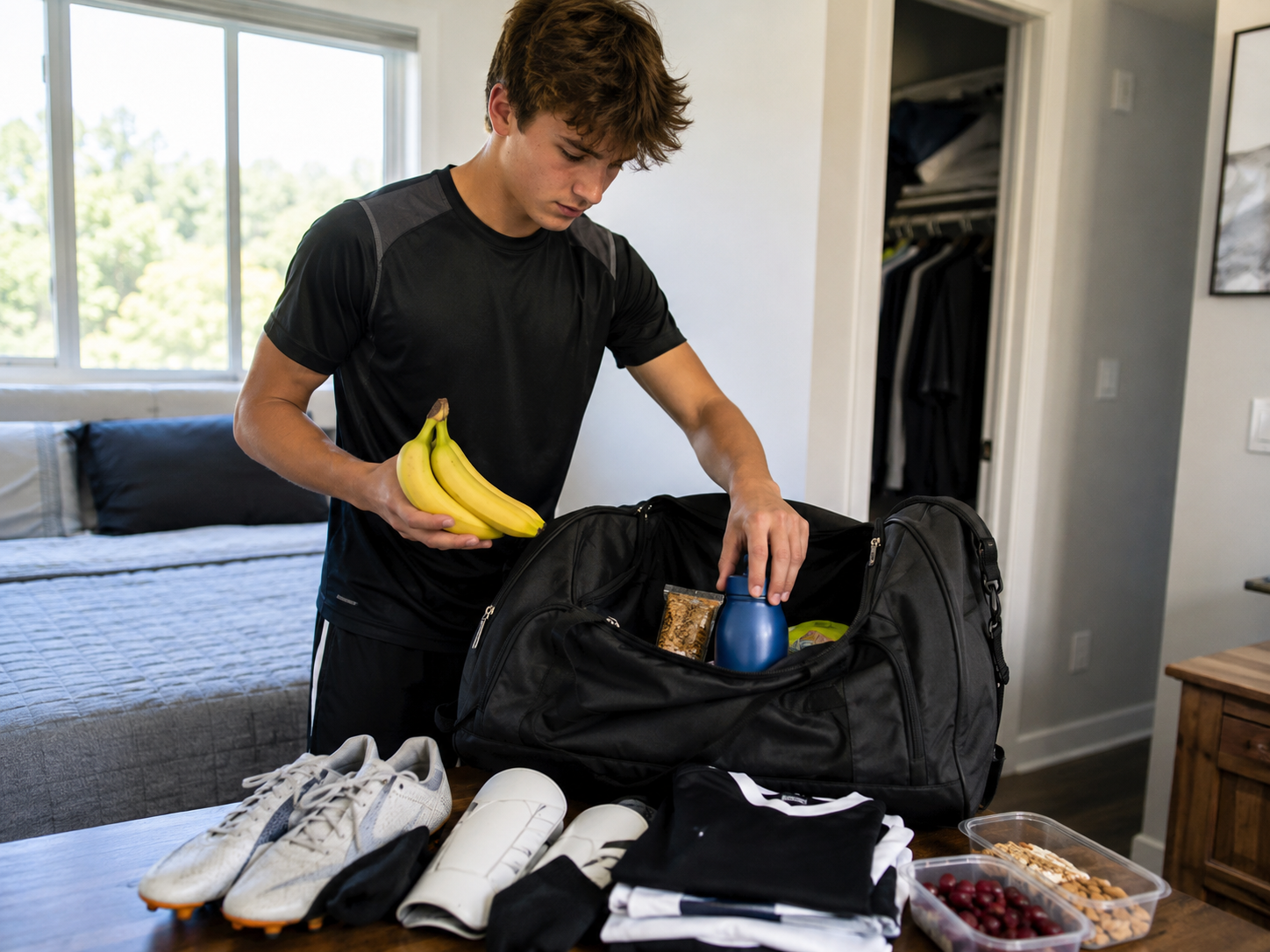
Every scenario above gets easier if the right food is already with you. The away-game bag is the whole strategy in one place. Pack portable easy-energy foods you already like, like bananas, pretzels, bagels, and granola bars. Add a simple protein option, such as jerky or a familiar shake. Throw in the one comfort food you always eat before you play well. And bring fluids, with a real plan to sip throughout the day and not simply chugging at kickoff.
There is one rule that ties the entire bag together, and it is the most important sentence on any travel weekend: no new foods on a game day. The road, with its unfamiliar food and shared hotel spaces and packed schedule, is the worst possible place to test how your stomach handles something it has never seen. This is not a small concern. A 2012 study in the British Journal of Sports Medicine tracked an entire sixteen-week elite rugby tournament, with team physicians logging illness every single day across 22,676 player-days. The gut turned out to be the second-most-common site of illness, behind only the respiratory system. That is elite tournament data, not a youth-soccer statistic, and it is worth being clear about that. But the lesson translates cleanly and without alarm. Unfamiliar food, shared spaces, and a crowded schedule are exactly the conditions where stomach trouble shows up. That is why professional teams obsess over road food, and why "no new foods on game days" earns its spot as a rule rather than a suggestion.
What this actually comes down to
Travel is not the enemy, and the goal was never to eliminate the chaos of a tournament weekend. Good travel nutrition is not about controlling everything. Even the best-supported athletes on the planet lose sleep and eat off-schedule when they travel. The difference is that they plan for the night that will probably be short and the meal that will probably be improvised, instead of being surprised by them.
You/your athlete did the hard part already. You earned the roster spot, you put in the training, you showed up. Fueling the travel well is just making sure all of that work actually shows up when the whistle blows on game two. So the rundown:
- Pack the bag the night before
- Decide where the pre-game meal is coming from before you are hungry and rushed
- Protect the sleep you can protect
The away game is won or lost long before kickoff, and that is a fight you get to win in advance.
Frequently Asked Questions
What should a soccer player eat at a gas station before a game? Look for easy energy plus a little protein. A banana, a bagel, pretzels, or a small box of cereal pairs well with beef jerky, chocolate milk, or a small bag of nuts. Build a simple three-item grab: one easy-energy food, one protein, and a sports drink/water. Go easy on heavy, greasy, or brand-new items right before kickoff, and save those for after the game.
Why do soccer players run out of legs by the second or third game of a tournament? It usually traces back to accumulated sleep and routine disruption, not a fitness problem. Research on travel and team-sport performance has shown that the dip in sprint speed and repeat-sprint capacity is most pronounced throughout 3 days of travel, which is why the back half of a tournament weekend, after a short night in a strange bed and a day of off-schedule eating, is so often where performance disappears.
What should I pack in a soccer game day travel bag? Portable easy-energy foods you already like (bananas, pretzels, bagels, granola bars, animal crackers), a simple protein option (jerky or a familiar shake), one comfort food you always eat before playing well, and fluids with a plan to sip throughout the day. The one rule: nothing brand new on a game day, since the road is the worst place to test how a new food sits.
How can my athlete eat well when the only option is a hotel breakfast? Plan around what hotels reliably have, such as oatmeal, bagels, bananas, and eggs, leading with easy energy and adding a little protein. Then pack a backup the night before, like a bagel, a banana, or a shake they have used before, so a closed dining room or a long line never decides how your athlete fuels before an early kickoff.
Do I need to work with a sports dietitian to get this right? Not to apply the basics in this article, which are meant to be used on their own. Where families tend to want individual help is in building a travel and tournament fueling routine around their specific athlete, their schedule, and what their stomach actually tolerates on the road. That is exactly what the free 15-minute Discovery Call is for, and you can find the link at the end of this post.
-----------
If struggling to figure out how to navigate those travel scenarios, that's what I'm here to support you with. Book a free 15-minute Discovery Call and we will walk through what a travel schedule could look like and figure out what steps would help you improve the most. Book Your Discovery Call
Jay Short, MS, RD, CSSD is a Registered Dietitian and Board Certified Specialist in Sports Dietetics, and co-owner of Rise Nutrition, specializing in sports dietetics for competitive athletes. He works with US Soccer (all 27 teams), the Columbus Blue Jackets (NHL), and athletes across MLS, collegiate, and club programs.
-----------
References
- Fowler PM, Knez W, Crowcroft S, et al. Greater Effect of East versus West Travel on Jet Lag, Sleep, and Team Sport Performance. Medicine & Science in Sports & Exercise. 2017;49(12):2548–2561. https://pubmed.ncbi.nlm.nih.gov/28719491/
- Fowler PM, Knez W, Thornton HR, et al. Sleep Hygiene and Light Exposure Can Improve Performance Following Long-Haul Air Travel. International Journal of Sports Physiology and Performance. 2021;16(4):517–526. https://pubmed.ncbi.nlm.nih.gov/33152686/
- Collins J, Maughan RJ, Gleeson M, et al. UEFA expert group statement on nutrition in elite football. British Journal of Sports Medicine. 2021;55(8):416–442. https://pubmed.ncbi.nlm.nih.gov/33097528/
- Schwellnus M, Derman W, Page T, et al. Illness during the 2010 Super 14 Rugby Union tournament: a prospective study involving 22,676 player days. British Journal of Sports Medicine. 2012;46(7):499–504. https://pubmed.ncbi.nlm.nih.gov/22554839/

Ready to Take Your Nutrition
to the Next Level?
Stop guessing and start getting results. Book a free discovery call
to find the right coaching program for your goals.