
Too Nervous to Eat Before a Soccer Showcase? The Fueling Fix
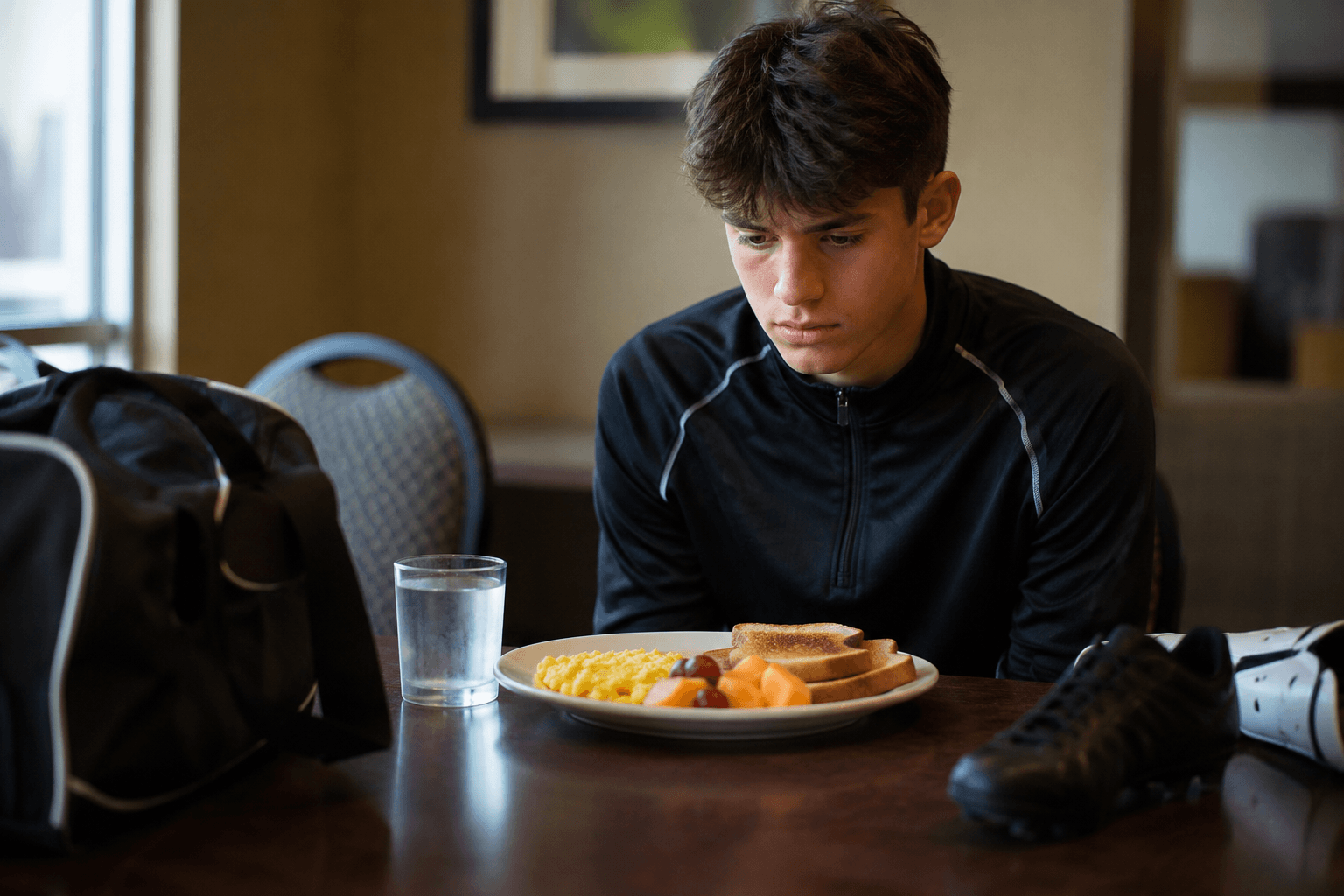
The morning of a showcase, a player who eats a full breakfast every other day of the year suddenly cannot get a single bite down. The coaches are in the stands. The scholarship feels like it is riding on the next ninety minutes. And the stomach, of all things, picks that exact moment to shut the door.
If that sounds familiar, you are not weak and you are not bad with nerves. Your body is doing something old and automatic, and once you understand it, you can build around it. That is the whole point of this. We are not going to try to talk you out of being nervous before the games that matter. We are going to make sure you can still fuel for them despite those nerves.
Your body cannot tell the difference between a coach and a threat
Here is what is actually happening when your appetite vanishes before a big game. Your nervous system reads pressure as danger. A coach evaluating you, a roster spot on the line, a college scout with a clipboard. To the part of your brain that runs the stress response, all of that registers the same way a physical threat would. And when your body thinks it might need to fight or run, digesting food drops to the bottom of the priority list. Blood and resources get pulled toward your muscles and away from your gut.
That is why food can sit in your stomach like a brick, or why you are not hungry at all. A controlled study in healthy adults found that the kind of stress that comes from anticipating a stressful event suppressed the normal rise in appetite that happened when people were calm. The stress of expecting something hard switched hunger off. That is almost exactly what pre-evaluation nerves are: your body reacting to something stressful that has not even happened yet.
Now, the honest part. This does not hit everyone the same way. When researchers directly tested how psychological stress affects the stomach, they found no single group pattern at all. Some people's digestion slowed down, some sped up, and most did not change. The response tracked with individual differences between people. So some athletes lose their appetite completely, some get a churning, nervous stomach, and some can eat a full meal before kickoff without a second thought. There is no universal rule here. There is your pattern, and the first real skill is knowing it.
Under-fueling does not announce itself
The reason this matters is that the cost shows up late, and it shows up disguised as something else.
Showing up under-fueled almost never feels like "I didn't eat enough." It feels like heavy legs in the second half. It feels like an empty tank when the game is still tied. It feels like being a half step slow in the exact moment a coach is scanning the field for the player who makes a difference. The fuel you skipped in the morning because your stomach said ‘no’ becomes the dip in performance nobody can explain at 4 p.m.
And under-fueling genuinely registers in the body, not just in your performance. In a study of college team-sport athletes, one of the most commonly reported complaints during exercise was hunger pain, the body literally flagging an empty tank in the middle of competition. When you are being evaluated, you do not get a do-over for a flat performance. The margin between making the team and not making it can be one half where you ran out of gas.
The good news buried in all of this is that fuel is an input you control. You cannot always control your nerves but you can control the plan surrounding those nerves. So let’s dive into that very plan.
Step one: front-load your fuel
Nerves typically spike closest to the event. So the worst possible time to try to force down a meal is forty-five minutes before kickoff, when your stomach is already in lockdown.
The fix is to get meaningful fuel in earlier in the day, and the night before, while your appetite still works the way it is supposed to. A real dinner the night before and a breakfast you can actually stomach do far more for a 3 p.m. game than anything you choke down at 2:15. Game days start the night before. By the time the nerves hit, the important fueling should already be done, with smaller and easier top-ups as you get closer rather than one big meal you are dreading.
Step two: go lighter when the nerves hit
When your stomach is in nerve mode, forcing a full plate backfires. The move is to shift toward easy-to-digest, familiar, carb-forward options. Liquids especially. A smoothie or a sports drink will go down when a plate of food will not, which is exactly why they earn their place on the mornings you cannot eat.
What to pull back on is the heavy, slow-to-clear stuff. In a survey of nearly four hundred competitive runners, the foods athletes most often avoided before racing were high-protein options like meat, fish, and poultry, along with milk products and high-fiber foods. They were right in doing so because those tend to sit longest, which is the kind of thing that backfires when the gut is already under pressure.
This is where one of the most common mistakes shows up. Protein is great and is not the enemy. But the pre-game meal is not the time to load up on it, especially an amount your body is not used to. In a randomized trial of basketball players, adding an unfamiliar amount of protein to the pre-game meal increased nausea during and after they played. The right nutrient at the wrong time, in an unfamiliar amount, still works against you. Which leads straight to the most important rule of all.
Step three: make it a routine, and never try anything new
A routine wins for two reasons.
The first is that your gut adapts to what you practice. Sports nutrition researchers describe "training the gut" as a real, usable strategy: the more you rehearse your pre-game fueling in training, the better your stomach tolerates it when it counts. Your digestion is trainable, same as the rest of you.
The second is that routine itself takes the edge off the nerves. When everything about your pre-game is familiar and decided in advance, there is nothing new to worry about. Familiarity quietly tells your nervous system that you have done this before and you are safe.
That is why the hard rule is no new foods on game day. Not the new gel a teammate hands you. Not the unfamiliar breakfast at the tournament hotel. Not the bigger protein serving you have never tried. The basketball study above points right at this: it was the unfamiliarity, not the protein itself, that the researchers flagged as the likely cause of the nausea. The best players in the world do not improvise before the biggest match of their lives. They eat the same thing they always eat, because routine is a performance tool.
The part that wrecks showcase weekends
Everything above is true for a single big game. A showcase, an ID camp, or a multi-day combine is a different animal, because the problem compounds.
Picture the weekend. Saturday morning nerves suppress your appetite, so you under-fuel for the first game. You do not recover well overnight, because you started the day already behind. Then Sunday morning the nerves hit again, and it happens a second time. By the third game, the gap between you and afresh opponent is real, and that is precisely when the coach you drove four hours to impress is still watching.
This is not random, and it is not a small group. In that same study of competitive runners, the athletes who restricted food the most before competing were the younger and more competitive ones. That describes the showcase athlete almost perfectly: a hungry, ambitious teenager at the most important evaluation of their year, in exactly the group most likely to be fighting their own stomach.
The athletes who finish a showcase as strong as they started are usually not the ones with the calmest nerves. They are the ones running a system on autopilot. Fuel front-loaded the night before and early in the morning. Easy, familiar options between games when the appetite is gone. Sleep and recovery protected like part of the competition, because they are. When you have a system, you do not have to find the appetite in the moment. The plan carries you when the nerves do not cooperate.
If that fade-in-game-two pattern sounds like you, that is not a character flaw and it is not something you will simply outgrow with more grit. It is a fixable fueling pattern, and building the system is exactly the kind of thing a sports dietitian helps with.
Start with one thing
You do not need to overhaul everything before the next event. Pick the one move that fits your pattern. If you lose your appetite entirely, work on front-loading the night before. If food sits heavy, practice the lighter, liquid options. If the big multi-day events are where it falls apart, build the routine and rehearse it.
Then practice it in training first, when it does not count, so it is automatic when it does. Pick one, run it for a week, and see what your body tells you. That is how a nervous stomach stops deciding your evaluation days for you.
-----------
Frequently Asked Questions
What should I eat before a game if I'm too nervous to eat anything at all? Go liquid. This is exactly when a smoothie or a sports drink earns its place, because your body will take in fuel as a liquid even when it rejects solid food. Start small and familiar rather than aiming for a perfect meal you cannot finish. In a survey of nearly four hundred competitive runners, the foods athletes most often avoided before competing were high-protein and high-fiber options which are exactly what should be limited. I’d toss high fat foods into that list as well though. So lighter and carb-forward is the direction to lean when your stomach is shutdown.
Why do I lose my appetite before big games but not normal ones? Because your body reacts to elevated pressure the same way it reacts to a threat. A controlled study in healthy adults found that the stress of anticipating a stressful event suppressed the normal rise in appetite. The bigger the perceived stakes, the stronger that response tends to be, which is why a random league game feels fine and a showcase shuts your stomach down.
Is it bad to eat protein before a game? Protein is not the problem, but a big or unfamiliar amount right before competition can be. In a randomized trial of basketball players, adding an unfamiliar amount of protein to the pre-game meal increased nausea during and after play. Save the larger protein serving for your recovery meal afterward, when it does its real work, and keep the pre-game meal lighter and familiar.
How do I stop fading in the second or third game of a showcase weekend? The fade usually traces back to under-fueling that compounds across days, not to fitness. Nerves suppress appetite on day one, recovery suffers overnight, and the deficit stacks. The fix is a repeatable system: front-load fuel the night before and early in the morning, use easy and familiar options between games, and protect sleep. Younger, more competitive athletes are the most likely to restrict food before competing, so this hits the showcase population hardest.
Can a sports dietitian actually help with this, or is it just nerves? Both can be true, but they are different problems with different fixes. Calming the nerves is one lane. Building a fueling system that performs even when the nerves do not calm down is another, and that is the part a sports dietitian builds with you. If you or your athlete keep hitting the wall of not being able to eat before big games, or fade late in showcase weekends, that is a fuelable, buildable pattern, not just something to white-knuckle through.
-----------
If you can't stomach food before big games, or fade in game two of every showcase weekend, that pattern is fixable, and it starts with a conversation. Book a free 15-minute Discovery Call and we'll figure out what the key challenges are for you and how we can work to navigate them. Book Your Discovery Call
Jay Short, MS, RD, CSSD is a Registered Dietitian and Board Certified Specialist in Sports Dietetics, and co-owner of Rise Nutrition, specializing in sports dietetics for competitive athletes. He works with US Soccer (all 27 teams), the Columbus Blue Jackets (NHL), and athletes across MLS, collegiate, and club programs.
-----------
References
- Nakamura C, Ishii A, Matsuo T, Ishida R, Yamaguchi T, Takada K, Uji M, Yoshikawa T. Neural effects of acute stress on appetite: A magnetoencephalography study. PLoS One. 2020. https://doi.org/10.1371/journal.pone.0228039
- Magni G, Cadamuro M, Borgherini G, Mastropaolo G, Di Mario F. Psychological stress and gastric emptying in normal subjects. Psychol Rep. 1991. https://doi.org/10.2466/pr0.1991.68.3.739
- Wardenaar FC, Schott KD, Mohr AE, Ortega-Santos CP, Connolly JE. An Exploratory Study Investigating the Prevalence of Gastrointestinal Symptoms in Collegiate Division I American Football Athletes. Int J Environ Res Public Health. 2023. https://doi.org/10.3390/ijerph20156453
- Parnell JA, Wagner-Jones K, Madden RF, Erdman KA. Dietary restrictions in endurance runners to mitigate exercise-induced gastrointestinal symptoms. J Int Soc Sports Nutr. 2020. https://doi.org/10.1186/s12970-020-00361-w
- Gentle HL, Love TD, Howe AS, Black KE. A randomised trial of pre-exercise meal composition on performance and muscle damage in well-trained basketball players. J Int Soc Sports Nutr. 2014. https://doi.org/10.1186/1550-2783-11-33
- Jeukendrup AE. Periodized Nutrition for Athletes. Sports Med. 2017. https://doi.org/10.1007/s40279-017-0694-2

Ready to Take Your Nutrition
to the Next Level?
Stop guessing and start getting results. Book a free discovery call
to find the right coaching program for your goals.