
Training While Sick: Should Your Soccer Player Play or Rest?
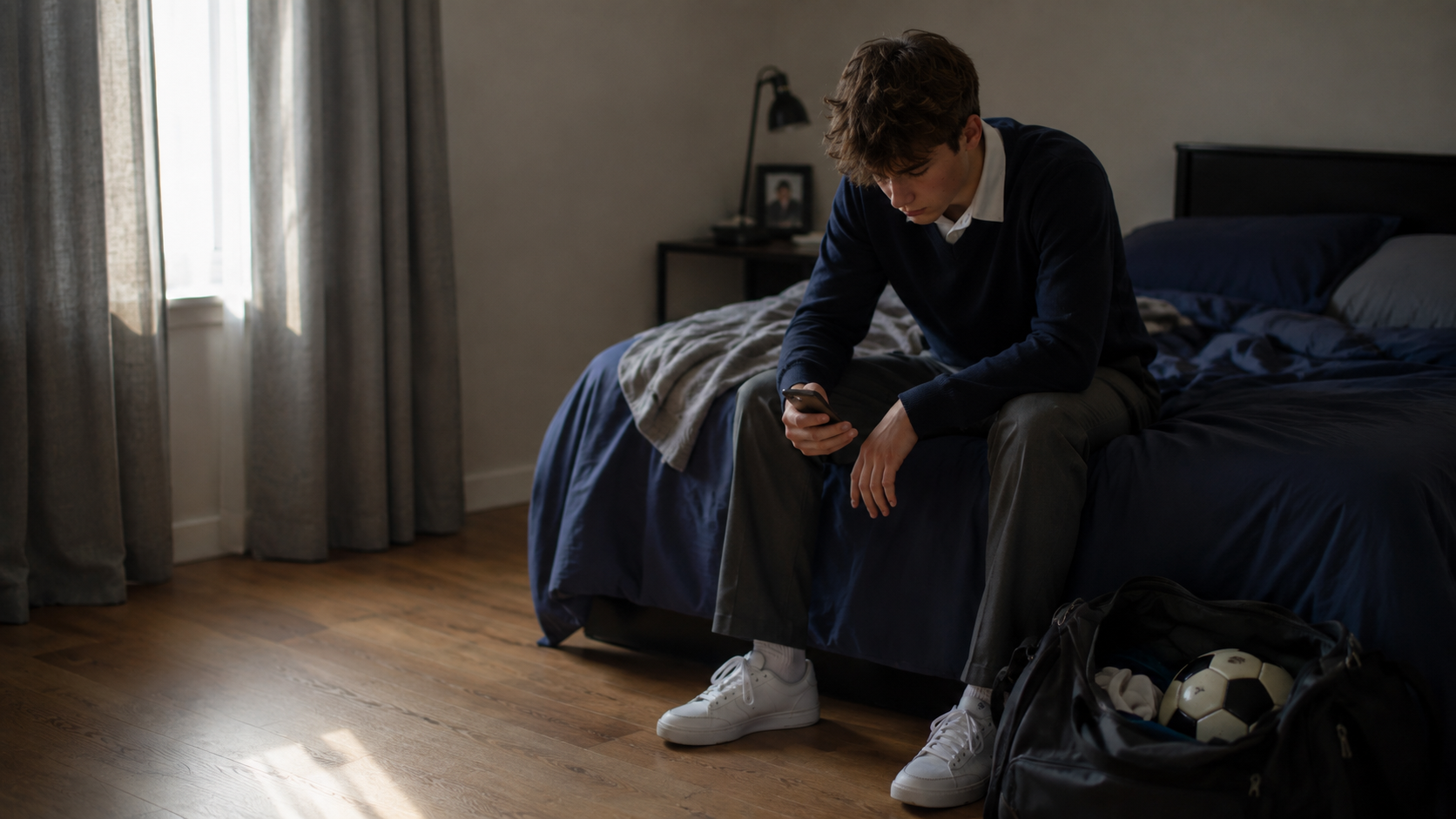
It is a Tuesday in the second week of school, it is seven in the morning, and there is a decision to make in about four minutes. Your athlete says they feel rough, yet they also have practice at four and a game on Saturday.
The short version, before the detail. A mild illness is usually not a reason to sit out entirely, and the evidence on training through a head cold is more reassuring than most people expect. Performance drops immediately, so plan for a worse session than usual. And four specific symptoms end the conversation regardless of anything else.
The advice you will find everywhere is the neck check. Train if symptoms are above the neck, rest if they are below it. Somewhere on a forum, an athlete tried to apply that rule and wrote this: "I'm just not sure where a cough falls on that chart."
That sentence is the problem in one line.
Where did the neck check rule come from?
It began as expert opinion rather than as a research finding. The International Olympic Committee's 2022 consensus statement on acute respiratory illness in athletes describes these expert opinions as initially based on no data to support the guidelines, and says there is still little research available to support a sound scientific approach to returning to sport after a respiratory infection.
A 2024 review in the Journal of Sport and Health Science calls the neck check rule nonscientific, then adds that it may still be partly useful.
Calling it bad advice overstates things. It is a rough guide being asked to do a job it was never built for. The rule sorts symptoms into two categories. A parent at seven in the morning is deciding about one specific session on one specific day, and those are different tasks.
The same review undercuts the sorting logic more directly. Some infections that present as ordinary upper respiratory symptoms are caused by viruses that reach the bloodstream, which means a sore throat is not automatically the harmless category the chart implies.
Is it safe to train through a cold?
In the only controlled human test of this question, yes. Researchers deliberately gave a rhinovirus (the common cold) to 50 adults aged 18 to 29 of moderate fitness, and 34 of them continued exercising at moderate intensity. Illness severity and duration did not differ between the groups, so training through that cold neither made anyone sicker nor extended how long the illness stuck around.
That is reassuring, and it is half of the picture.
A separate review of 17 studies covering athletes, physically active people and military personnel aged 15 to 65 found that respiratory infection was associated with immediate drops in sport performance and in lung function, while endurance test results in mild cases barely moved.
Put those together and you get something more useful than a rule. Training through a mild illness will probably not cost the week but it will very likely cost the session. Going in already expecting that is a different experience from discovering it in the sixtieth minute and concluding something is wrong.
When should an athlete definitely not train?
Four symptoms are absolute stops: chest pain, fainting, shortness of breath, and a racing heart. Any one of them means no exercise and a call to a physician. That is not weighed against how important the game is, and it is not a decision for a coach or a parent to make on the sideline.
It is also fair to say what the broader fear rests on, because it drives a lot of anxious calls. Heart muscle damage caused by exercising during a respiratory virus has not been reported in humans. A UK review of 756 adolescent sudden cardiac deaths, including 128 competitive athletes, found heart inflammation as the cause in 30 of them, and none of those 30 were among the athletes.
The four symptoms still stand as a hard stop. The broader fear of a routine cold damaging a healthy teenager's heart during a training session does not carry the evidence most people assume it does. A big thing though is to always consult your doctor just to make sure and especially if ever unsure.T
How much fitness do you lose by sitting out?
Very little, and far less than most athletes believe. A systematic review pooling 54 studies and 31,065 athletes and military recruits aged 15 to 65 found that in 80 percent of respiratory illness episodes, no days were lost from training or competition at all. Average symptom duration across all of them was about seven days.
When training genuinely does stop, the loss takes weeks to appear. A meta-analysis of training stoppage in resistance trained adults found that the drop in maximal force and power did not become statistically significant until somewhere between the third and fourth week away from training.
Three days is nowhere near that. Neither is even a whole week.
Why does the first session back feel so bad?
Because of what happened to food and fluid across those days. This part is what I watch happen every single season rather than something I can point to a study for.
For those three days, the athlete barely eats and barely drinks. Appetite is the first thing to go, and nobody notices, because training has stopped and no one is paying attention to intake on a rest day.
Then day four arrives, they feel well enough, they walk into a full session running on three days of almost nothing, and it is awful. The story that gets told about that session is always about lost conditioning.
In reality it was four days of missed food and fluid with a full session stacked on top of it.
Which is why the order matters more than anything else here. Get eating and drinking back to normal first, for one full day, and then add the load. Normal means the meals and snacks that would usually be there, at roughly the usual times.
I should be equally straight about the limits of that. There is no validated return ramp for coming back from illness in athletes. The reason to ease in is the intake that was missed, and that reasoning comes from clinical experience rather than from a trial.
What prevents illness in high school athletes?
Sleep is the only lever with population data on this exact age group. The CDC surveyed a nationally representative sample of 15,624 US students in grades 9 to 12 and found short sleep duration in 72.7 percent of high school students, with short sleep defined as under eight hours. The recommendation for 13 to 18 year olds is eight to ten hours.
So an athlete getting under eight hours is not the exception. They are the clear majority. And this is the exact two weeks it gets worse, because school has restarted, practice has moved to the evening, and homework has moved after practice while the alarm has not moved at all.
One more study is worth knowing. Researchers followed 44 male nationally competitive Australian Football athletes across a full 46-week season. At first look, sprint distance, total running distance and sleep were all associated with illness. Once every significant variable was controlled for together, recent sleep quantity was the one that held up, and external training load no longer showed a relationship with illness.
That is adults, in a different sport, across one season. And nobody has run the trial that proves adding sleep prevents illness in athletes, so the association exists while the intervention remains unproven.
It is still the first thing I would change, because it costs nothing and it is available tonight.
How should you make the call on the morning?
Replace the chart with three questions. Ask what today's session is for. Ask what tomorrow needs from that athlete. Ask whether anything on that list of four symptoms applies.
A technical or recovery day with a head cold and normal energy is a different answer from a fitness block. A Tuesday session in the third week of a long season is a different answer from the last training day before a showcase. And if any of those four symptoms are present, none of the rest is relevant.
One last piece of context for why this is worth the thought. Across five seasons of international track and field athletes, those who completed more than 80 percent of their planned training weeks were seven times more likely to reach the performance goal they had set. No confidence interval is reported for that figure, and those are adult individual-sport athletes, so hold the number loosely.
The idea holds anyway. The weeks your athlete was available are part of their record, quietly, whether anyone is tracking them or not.
-----------
Frequently Asked Questions
Can you train while sick?
Usually yes, with limits. In the only controlled human test, adults given a cold virus who kept training at moderate intensity did not get sicker or stay sick longer. Performance is what changes, and it drops right away. Chest pain, fainting, shortness of breath or a racing heart are the exception and mean no exercise and a call to a physician.
How much fitness does my athlete lose if they miss three days?
Almost certainly none that can be measured. Pooled research in resistance trained adults found no statistically significant drop in strength or power until between the third and fourth week away from training. What does get lost across a short illness is food and fluid intake, and that is usually what makes the first session back feel so poor.
Do immune supplements work for athletes?
They tend to change the experience of an illness more than the odds of getting one, and one thing to be clear on first is that all of this research tests vitamin C supplements at 200mg a day or more, commonly a gram or more, rather than vitamin C from food. Vitamin C is the clearest example. In community trials of more than 10,000 people, daily supplementation did not reduce how often people caught colds, though in five trials of 598 marathon runners, skiers and soldiers on subarctic exercises it roughly halved the rate. Taken daily it shortened colds by about 8 percent in adults and 14 percent in children. Started after symptoms appeared it showed no consistent benefit, though the review notes few trials have tested that specifically, and it is the version almost everyone uses.
What should we do if my athlete is sick right before a tournament or showcase?
Work backward from the date rather than forward from today. A missed midweek session gets absorbed, but a showcase or a tryout has no makeup date, which makes the two weeks in front of it the part worth protecting. In practice the two things that collapse in that window are sleep and eating, and they collapse because the athlete is nervous rather than careless.
When is it worth talking to a sports dietitian about this?
When the pattern repeats. One illness in a season is ordinary. Flat by week two and sick by week three, three seasons running, is a pattern, and patterns usually have something structural underneath them like a sleep schedule, a training load jump, or an intake gap nobody has mapped. That is what a free 15-minute Discovery Call is for.
-----------
If your athlete has started the last few seasons the same way, and there is a showcase or a tryout circled on the calendar this fall, that pattern is worth looking at before the season decides it for you. Book Your Discovery Call
Jay Short, MS, RD, CSSD is a Registered Dietitian and Board Certified Specialist in Sports Dietetics, and co-owner of Rise Nutrition, specializing in sports dietetics for competitive athletes. He works with US Soccer (all 27 teams), the Columbus Blue Jackets (NHL), and athletes across MLS, collegiate, and club programs.
-----------
References
1. Schwellnus M, Adami PE, Bougault V, et al. International Olympic Committee (IOC) consensus statement on acute respiratory illness in athletes part 1: acute respiratory infections. *British Journal of Sports Medicine.* 2022;56(19):1066-1088. [Full statement](https://stillmed.olympics.com/media/Documents/Athletes/Medical-Scientific/Consensus-Statements/Acute-respiratory-illness-in-athletes-part-1.pdf)
2. Ruuskanen O, Valtonen M, Waris M, Luoto R, Heinonen OJ. Sport and exercise during viral acute respiratory illness: time to revisit. [https://pubmed.ncbi.nlm.nih.gov/38072364/](https://pubmed.ncbi.nlm.nih.gov/38072364/)
3. Weidner TG, Cranston T, Schurr T, Kaminsky LA. The effect of exercise training on the severity and duration of a viral upper respiratory illness. [https://pubmed.ncbi.nlm.nih.gov/9813869/](https://pubmed.ncbi.nlm.nih.gov/9813869/)
4. Kaulback K, Pyne DB, Hull JH, Snyders C, Sewry N, Schwellnus M. The effects of acute respiratory illness on exercise and sports performance outcomes in athletes. [https://pubmed.ncbi.nlm.nih.gov/35695464/](https://pubmed.ncbi.nlm.nih.gov/35695464/)
5. Snyders C, Pyne DB, Sewry N, Hull JH, Kaulback K, Schwellnus M. Acute respiratory illness and return to sport: a systematic review and meta-analysis. [https://pubmed.ncbi.nlm.nih.gov/34789459/](https://pubmed.ncbi.nlm.nih.gov/34789459/)
6. Bosquet L, Berryman N, Dupuy O, Mekary S, Arvisais D, Bherer L, Mujika I. Effect of training cessation on muscular performance: a meta-analysis. [https://pubmed.ncbi.nlm.nih.gov/23347054/](https://pubmed.ncbi.nlm.nih.gov/23347054/)
7. Wheaton AG, Jones SE, Cooper AC, Croft JB. Short Sleep Duration Among Middle School and High School Students, United States, 2015. [https://pubmed.ncbi.nlm.nih.gov/29370154/](https://pubmed.ncbi.nlm.nih.gov/29370154/)
8. Fitzgerald D, Beckmans C, Joyce D, Mills K. The influence of sleep and training load on illness in nationally competitive male Australian Football athletes. [https://pubmed.ncbi.nlm.nih.gov/29945830/](https://pubmed.ncbi.nlm.nih.gov/29945830/)
9. Hemilä H, Chalker E. Vitamin C for preventing and treating the common cold. [https://pubmed.ncbi.nlm.nih.gov/23440782/](https://pubmed.ncbi.nlm.nih.gov/23440782/)
10. Raysmith BP, Drew MK. Performance success or failure is influenced by weeks lost to injury and illness in elite Australian track and field athletes. [https://pubmed.ncbi.nlm.nih.gov/26839047/](https://pubmed.ncbi.nlm.nih.gov/26839047/)

Ready to Take Your Nutrition
to the Next Level?
Stop guessing and start getting results. Book a free discovery call
to find the right coaching program for your goals.