
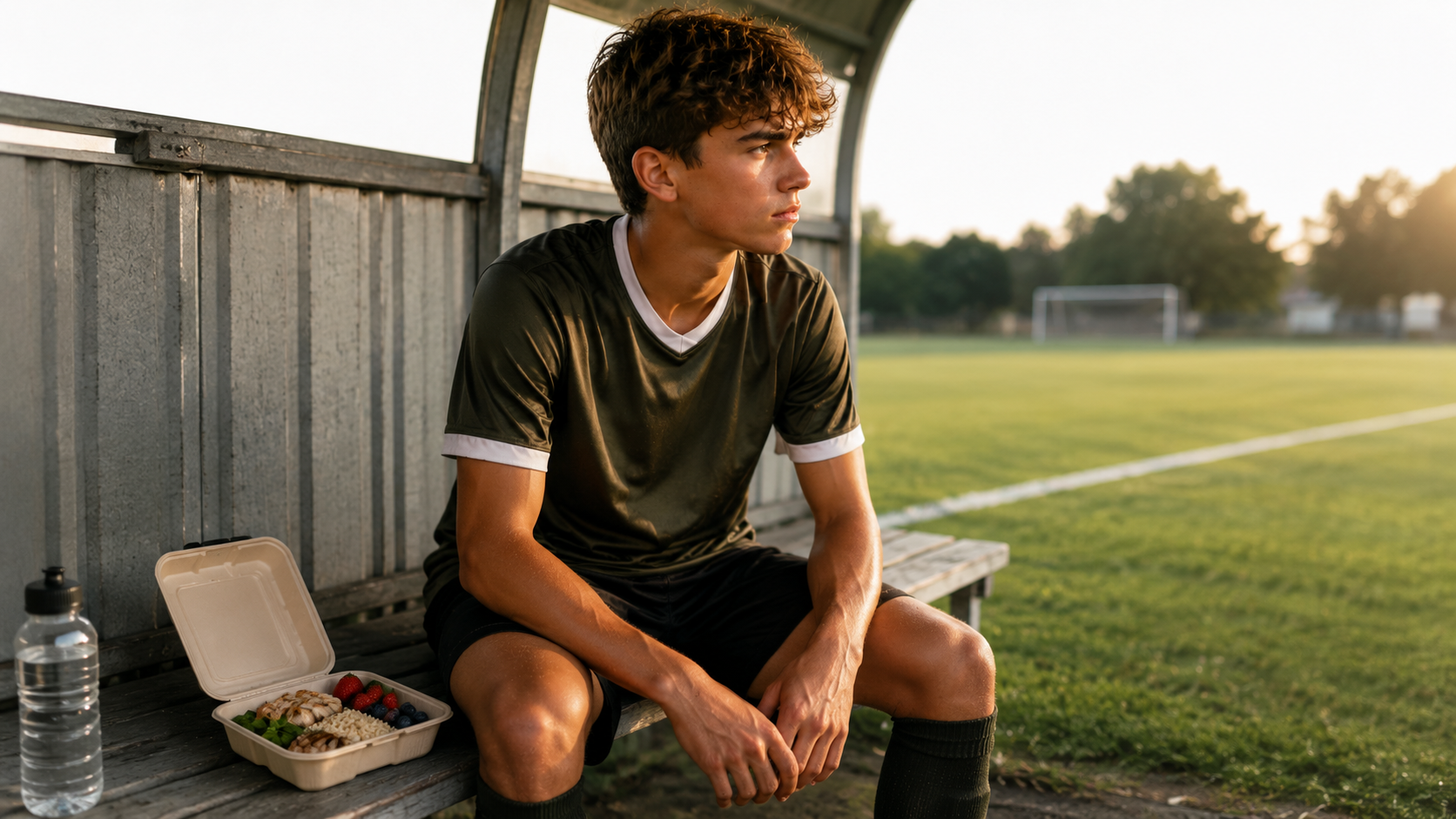
Why Soccer Players Feel Heavy at Kickoff (And What Actually Fixes It)
"I just can't eat before games."
I hear that constantly, and almost every athlete who says it has decided it is simply how their body works. If you are a parent who went looking for an answer because your kid gets sick before kickoff, or an athlete who has quietly given up on pre-game meals, that belief is the first thing worth taking apart.
Most athletes go looking for the food that did it to them. What usually explains it is how much food there was and how many hours sat between the last bite and the first whistle. Both are fixable, and neither requires eating less.
That matters, because an athlete who decides a food betrayed them starts cutting food. And in my experience, the athlete who eats less before games is the one whose legs are shot by the sixty-fifth minute.
Why the same meal feels fine on Wednesday and awful on Saturday
Start with the part that doesn't get checked enough: the actual amount.
Researchers publishing in the Journal of Nuclear Medicine fed healthy adults the same solid meal at three different sizes and tracked how long the stomach took to empty half of it. The small version was halfway out in 57 minutes. Double that amount took 70 minutes. Four times the smallest took 95 minutes. The recipe never changed. Only the portion did.
So four times as much food took roughly forty minutes longer to get halfway out of the stomach, even though the food itself was identical.
Put that against a real schedule. The pre-game meal that works beautifully before a 7 PM kickoff has barely started moving before a 4 PM one. The runway simply got shorter.
What the meal is made of matters less than you think
Athletes spend enormous energy interrogating ingredients, and the research keeps pointing somewhere else. Work in the Journal of Physiology compared meals of genuinely different composition and found that half-emptying time tracked almost perfectly with how energy dense each meal was, while the makeup of the meal played only a minor role by comparison. How quickly a meal leaves the stomach tracks with how much is in it far more than with what it is made of.
That changes the order of operations. Check the amount and the clock first. For most athletes, ingredients never become the problem at all. Fat and fiber content are two exceptions to this, though. Fat falls in line with what was stated above in that it is more energy-dense, so consuming more of it is going to result in a slower digestion rate. Fiber is a unique one in that its structure just takes longer for the body to be able to break down and can result in delayed digestion.
One additional caveat. Every study here was done in adults, most in longer-duration sports. The mechanisms transfer, but nobody has measured the exact clock for a 15 year old, so treat this as the order to work through rather than a prescription.
The 4 PM kickoff, walked through hour by hour
The hardest version of this is not a tournament. It is an ordinary Tuesday high school game.
School lunch lands around 11:30. The bus leaves at 2:15. Kickoff is at 4. Somewhere in there an athlete is supposed to eat a real meal, and the schedule was not built with that in mind.
What usually happens
Breakfast is small or skipped, because the game is already on their mind and nothing sounded good at 6:45. Lunch is whatever the cafeteria had, half of it uneaten. Panic arrives around 2 PM, so they eat something substantial twenty minutes before the bus.
That final meal is the one sitting there at kickoff, and it gets blamed for the whole day. It was really just the only meal that happened.
What to change first
Work backwards from 4 PM instead of forwards from lunch.
The last full meal wants to land three to four hours before kickoff, which on this schedule makes the school lunch period the pre-game meal by default. That reframing does most of the work by itself. When I am planning with US Soccer, the pre-match meal goes on the schedule three and a half hours before kickoff, and the rest of the day is built around that fixed point.
The 2 PM window then becomes a snack rather than a rescue meal. Something small and familiar, with carbohydrates the athlete has eaten before a game already.
And breakfast becomes the meal that decides the afternoon. What I see over and over is nerves building slowly across a game day morning while the desire to eat drops away, so the athlete waits on hunger that was never going to arrive. Eating before it feels appealing is a skill, and for a later kickoff it is the most valuable habit on this list.
When nothing sounds good
The four things athletes tell me most: I'm not hungry. Nothing sounds good. Anytime I try to eat it doesn't sit well. And I don't want to chew anything.
That last one gets read as a kid being difficult. It is useful information about what will go down, and it points at its own answer. The body is asking for fuel, and chewing at first though is the only way to deliver it.
So to address that as kickoff approaches, food changes shape rather than disappearing. Smaller, simpler carbohydrate, more of it liquid to avoid chewing completely. Two hours out, a banana and some toast works for most athletes. Thirty minutes out, that same athlete usually does better with a sports drink or a smoothie. That progression comes from my practice rather than from a trial, and it is the most useful adjustment I make with athletes who have written off pre-game eating.
The game after the really healthy dinner
Every so often an athlete does everything right and feels terrible for it. Big salad, a bean bowl, all the food anyone would applaud, then a miserable first half.
A 2025 review in Sports Medicine explains why. Athlete carbohydrate guidelines are well established, yet they contain no daily fiber recommendation at all, even though adjusting fiber is common practice for managing stomach comfort around competition. Where habitual fiber is low, those authors recommend building it up gradually across about six weeks, and they note that there are situations where deliberately easing fiber down keeps an athlete comfortable during exercise.
Your gut adapts to what it sees regularly. A big fiber load the night before a tournament is not bad eating. It is asking the gut to do something it has not practiced.
What you did the day before
Some carbohydrates ferment in your gut and make gas. Easing off them for roughly two days before a big competition can settle the stomach noticeably.
Worth saying clearly before anyone panics: these are ordinary, healthy foods. The usual ones are beans and lentils, apples and pears, large amounts of milk, and consuming a lot of sugar-free gum or mints. Nothing on that list is bad for you or off limits. We pull them back for about two days ahead of something big, and then they come straight back in.
A 2024 trial in Applied Physiology, Nutrition, and Metabolism tested that in trained adult athletes and found that the version higher in these carbohydrates made symptoms worse before and during exercise. A 2025 case series from the same group found that a supervised version of this approach in the 48 hours before a target event reduced symptoms and improved how much food athletes could tolerate. The 2025 joint position statement from Sports Dietitians Australia and the Ultra Sports Science Foundation lists this adjustment among the strategies with mostly beneficial outcomes.
One limit belongs in the same breath, because nobody selling a protocol will mention it. In that trial, distance covered did not differ between conditions. Stomachs felt better while performance stayed put, which makes this a short tool for a big weekend rather than a way of eating.
Showing up already short on fluid
An athlete who arrives behind on fluid has a slower stomach before they have eaten anything. A study in the European Journal of Applied Physiology tested trained adults both dehydrated and properly hydrated, and food left the stomach significantly more slowly when dehydrated. Nausea rose alongside it, and the size of the delay tracked closely with the size of the increase in nausea.
So the heavy feeling and the thirsty feeling often share a cause. An athlete who has barely drank since lunch and feels queasy in the first fifteen minutes is worth checking there first.
What happens when the whistle blows
At kickoff, blood gets redirected toward the legs and lungs and the stomach receives less of it. Digestion slows at the exact moment there is food sitting there, which is a collision of timing rather than a sign that something has gone wrong.
Now the part that plenty of content aimed at athletes gets wrong on purpose. A systematic review in Alimentary Pharmacology and Therapeutics concluded that measurable gut disruption/damage during exercise appears at around two hours of sustained, moderately hard effort, regardless of how fit the athlete is. A 90 minute match, and youth matches are often shorter, sits under that line. Athletes below it still feel symptoms, and those symptoms are real, but the game itself is not damaging the gut.
When it happens on ordinary days too
The most practically useful finding in this area has nothing to do with game day.
In a 2023 survey of team sport athletes published in the Clinical Journal of Sport Medicine, the strongest predictor of symptoms during training and competition was whether the athlete had symptoms at rest, on ordinary days. A separate 2023 study of a large group of adult athletes in BMJ Open Sport and Exercise Medicine found abdominal complaints were more common in younger athletes, in female athletes, and at higher training intensities.
So if an athlete's stomach is unsettled on a normal Tuesday, the fix starts on Tuesday.
Nerves belong here too as nerves can arise off the field as well. Research in the Journal of Sports Medicine and Physical Fitness found anxiety and gut sensitivity were related to symptoms during competition, while finding no relationship between anxiety and how much athletes actually ate or drank. Nerves change how the stomach feels, and that sensation is physical rather than imagined. Recognizing it as nerves keeps an athlete from cutting food they needed.
What the supplement aisle is selling your athlete
Any parent whose kid gets sick before games has already been sold something.
Probiotics are the big one, and worth being precise about. A 2022 systematic review in Nutrients pooled ten randomized controlled trials covering more than 800 athletes, found only slight evidence of benefit for gut symptoms, and could not identify which product works best. The 2025 position statement went further, placing probiotic supplementation among the interventions that reported negative outcomes. On its beneficial list: adequate carbohydrate and protein around exercise, and being properly hydrated going in.
My own position is narrower than a blanket dismissal, and I am not telling anyone to throw theirs out. What I will say is that no probiotic changes how fast a meal leaves the stomach, and that speed is the whole mechanism this article is about. Every athlete I have moved out of this problem got there the same way: shifting when they ate, easing off the volume sitting in there right before kickoff, and choosing food that suited the window. That is what settled their stomachs.
Debloat and greens powders deserve a mechanical answer. A concentrated fiber or prebiotic load delivered all at once is precisely the abrupt increase that fiber review warns against, so a product like that can produce the symptom it advertises fixing.
Cutting carbohydrate to reduce bloating runs the wrong way entirely. That same position statement lists low carbohydrate high fat approaches among the interventions with negative outcomes for gut symptoms. Particularly for individuals who don't generally consume higher fat foods.
On digestive enzymes and colostrum I have no verified evidence in either direction for athletes before competition, so I am not going to pretend otherwise. What I will say is that I have never seen one solve a problem that turned out to be a meal three hours too late.
This is trainable, which is the whole point
The belief that started this article, that some athletes simply cannot eat before games, is the part that turns out to be least true.
A 2017 study in Applied Physiology, Nutrition, and Metabolism put trained adult athletes through two weeks of repeated exposure, taking in carbohydrate during exercise over and over. Symptoms fell by about 60 percent, and performance in the test at the end improved by roughly four to five percent.
That study trained tolerance to fueling during exercise rather than to a pre-game meal, so applying it to rehearsing game day eating is an extension of the principle rather than something the trial measured. It is an extension I make with every athlete I work with, built on the same idea: the gut adapts to what it practices.
Which is why no new foods on game day stays a rule worth keeping.
Your one thing this week
Change one variable. Take the same meal, the same food, and eat it 30 to 60 minutes earlier. Keep everything else identical for seven days so you learn something from it.
If that alone fixes it, the food was never the issue. If it helps without solving it, the next places to look are the day before, what you arrived with in the tank, and whether this happens on ordinary days too.
What I actually see when athletes make that move goes further than comfort. Eating earlier means they are willing to eat more, because appetite has not dropped off yet and there is time for it to settle. So they walk out with more fuel on board rather than less, and they can push harder for longer. There is a mental piece too. They know what they put in, and knowing there is more in the tank changes how they play the last twenty minutes.
You are already doing the hard part. The training is done and the effort is not in question. This is a scheduling adjustment on top of work you have already put in.
MOVE THE CLOCK BEFORE YOU CUT THE FOOD.
-----------
Frequently Asked Questions
How long before a soccer game should my athlete eat?
Three to four hours before kickoff for the last full meal is the working rule for club and high school players, and a bigger meal needs more of that window. When I plan with US Soccer, it is scheduled three and a half hours out. After that meal, intake shifts to snacks that get smaller and simpler as kickoff approaches.
What should a soccer player eat before a game when they are not hungry?
Something small, familiar, and easy to get down beats nothing at all. As kickoff gets closer, food that requires less chewing tends to work better, so a sports drink or a smoothie often succeeds where a sandwich fails.
Is it better to eat less before a game if my athlete's stomach bothers them?
Eating less fixes the feeling and tends to create a different problem later in the match. Moving the meal earlier is worth trying first, since it addresses the timing without reducing what gets into the tank.
Do probiotics help athletes with stomach problems?
The evidence is weak. A systematic review of ten randomized trials in more than 800 athletes found only slight evidence of benefit and could not identify a best product, and the 2025 position statement placed probiotics among the interventions with negative outcomes. The more useful point is mechanical. No probiotic changes how fast a meal leaves the stomach, so it cannot fix a timing problem.
Can nerves cause stomach problems before a game?
Yes, and the sensation is physical rather than imagined. Research has linked anxiety and gut sensitivity to symptoms during competition, while finding no relationship between anxiety and how much athletes ate or drank.
How do I know whether my athlete needs help from a sports dietitian?
The clearest signal is a pattern that repeats. If an athlete fades in the same part of the game most weekends, or their stomach is unsettled on ordinary days rather than only before competition, that is worth an individual look rather than a general rule. Both are exactly what a Discovery Call is for.
-----------
If your athlete's stomach has been dictating what they can eat before games, that pattern is usually solvable once someone maps their real schedule against their real kickoff times. Book a free 15-minute Discovery Call and we will find where the runway is disappearing: Book Your Discovery Call
Jay Short, MS, RD, CSSD is a Registered Dietitian and Board Certified Specialist in Sports Dietetics, and co-owner of Rise Nutrition, specializing in sports dietetics for competitive athletes. He works with US Soccer (all 27 teams), the Columbus Blue Jackets (NHL), and athletes across MLS, collegiate, and club programs.
-----------
References
1. Velchik MG, Reynolds JC, Alavi A. The effect of meal energy content on gastric emptying. J Nucl Med. 1989;30(6):1106-1110. https://pubmed.ncbi.nlm.nih.gov/2738691/
2. Calbet JA, MacLean DA. Role of caloric content on gastric emptying in humans. J Physiol. 1997;498(Pt 2):553-559. https://pubmed.ncbi.nlm.nih.gov/9032702/
3. Mancin L, Burke LM, Rollo I. Fibre: The Forgotten Carbohydrate in Sports Nutrition Recommendations. Sports Med. 2025;55(5):1067-1083. https://pubmed.ncbi.nlm.nih.gov/39775524/
4. Scrivin R, Slater G, Mika A, Rauch C, Young P, Martinez I, Costa RJS. The impact of 48 h high carbohydrate diets with high and low FODMAP content on gastrointestinal status and symptoms in response to endurance exercise, and subsequent endurance performance. Appl Physiol Nutr Metab. 2024;49(6):773-791. https://pubmed.ncbi.nlm.nih.gov/38359412/
5. Scrivin R, Slater G, Costa RJS. Case Series: Management of Exercise-Associated Gastrointestinal Symptoms in Endurance Athletes Using a High-Carbohydrate Low-FODMAP Therapeutic Intervention. Int J Sport Nutr Exerc Metab. 2025;35(4):337-354. https://pubmed.ncbi.nlm.nih.gov/40049175/
6. Costa RJS, Gaskell SK, Henningsen K, Jeacocke NA, Martinez IG, Mika A, Scheer V, Scrivin R, Snipe RMJ, Wallett AM, Young P. Sports Dietitians Australia and Ultra Sports Science Foundation Joint Position Statement: A Practitioner Guide to the Prevention and Management of Exercise-Associated Gastrointestinal Perturbations and Symptoms. Sports Med. 2025;55(5):1097-1134. https://pubmed.ncbi.nlm.nih.gov/40195264/
7. van Nieuwenhoven MA, Vriens BE, Brummer RJ, Brouns F. Effect of dehydration on gastrointestinal function at rest and during exercise in humans. Eur J Appl Physiol. 2000;83(6):578-584. https://pubmed.ncbi.nlm.nih.gov/11192068/
8. Costa RJS, Snipe RMJ, Kitic CM, Gibson PR. Systematic review: exercise-induced gastrointestinal syndrome, implications for health and intestinal disease. Aliment Pharmacol Ther. 2017;46(3):246-265. https://pubmed.ncbi.nlm.nih.gov/28589631/
9. Wilson PB, Fearn R, Pugh J. Occurrence and Impacts of Gastrointestinal Symptoms in Team-Sport Athletes: A Preliminary Survey. Clin J Sport Med. 2023;33(3):239-245. https://pubmed.ncbi.nlm.nih.gov/36476634/
10. Baart AM, Terink R, Zwerver J, Witteman BJM, Mensink M. Exercise-related abdominal complaints in a large cohort of runners: a survey with a particular focus on nutrition. BMJ Open Sport Exerc Med. 2023;9(2):e001571. https://pubmed.ncbi.nlm.nih.gov/37304891/
11. Wilson PB, Ferguson BK, Mavins M, Ehlert AM. Anxiety and visceral sensitivity relate to gastrointestinal symptoms in runners but not pre- or during-event nutrition intake. J Sports Med Phys Fitness. 2023;63(7):846-851. https://pubmed.ncbi.nlm.nih.gov/36924472/
12. Costa RJS, Miall A, Khoo A, Rauch C, Snipe R, Camões-Costa V, Gibson P. Gut-training: the impact of two weeks repetitive gut-challenge during exercise on gastrointestinal status, glucose availability, fuel kinetics, and running performance. Appl Physiol Nutr Metab. 2017;42(5):547-557. https://pubmed.ncbi.nlm.nih.gov/28177715/
13. Łagowska K, Bajerska J, Kamiński S, Del Bo' C. Effects of Probiotics Supplementation on Gastrointestinal Symptoms in Athletes: A Systematic Review of Randomized Controlled Trials. Nutrients. 2022;14(13):2645. https://pubmed.ncbi.nlm.nih.gov/35807826/

Ready to Take Your Nutrition
to the Next Level?
Stop guessing and start getting results. Book a free discovery call
to find the right coaching program for your goals.