
What Should a Soccer Player Eat Before a Game? The 24-Hour Pregame Fueling System
The biggest pregame fueling mistake most soccer players make has nothing to do with the meal three hours before kickoff. It's the meal the night before.
Pregame fueling is the most impactful nutrition decision an athlete makes on game day, and it's the one most athletes get wrong without knowing it. The meal looks reasonable with the food choices feeling healthy but the timing and total volume don't actually match what 90 minutes of high-intensity intermittent running demands.
This guide walks through the three meals that matter most, the timing that determines whether the tank is full at kickoff, and the common mistakes that quietly cost the second half. It's written for parents researching how to support their athlete and for athletes who recognize the problem and want to fix it.
The Pregame Meal Doesn't Start on Game Day
Muscle glycogen, your carbohydrate stores and the fuel your body burns through during a soccer game, builds up across the 24 hours before the match starts. The carbohydrates you eat at dinner the night before, plus the meals across that prior day, are what fill the muscle tank by kickoff. The pregame meal can only top off what's already been loaded. It can't completely refill an empty tank.
Where many athletes lose ground: skipping carbs at dinner the night before because they want to "feel light" for the morning. They show up to kickoff in a fuel deficit that the pregame meal cannot make up.
The pregame meal still matters but it's the second decision in the system, not the first.
The Three Meals That Actually Fuel a 90-Minute Game
Pregame fueling is a three-meal system, not a single decision. Each meal does a job the next one cannot.
Meal 1: Dinner the night before. This is where match-day fuel actually starts loading. Real carbohydrates fill the muscle tank by kickoff. Pasta, rice, potatoes, or bread, pick what you/your athlete will actually eat. The Joint Position Stand from the Academy ofNutrition and Dietetics, Dietitians of Canada, and the American College ofSports Medicine recommends meaningful carbohydrate intake the day before competition for athletes in glycogen-demanding sports like soccer. It’s a universally agreed upon concept, don’t skip it!
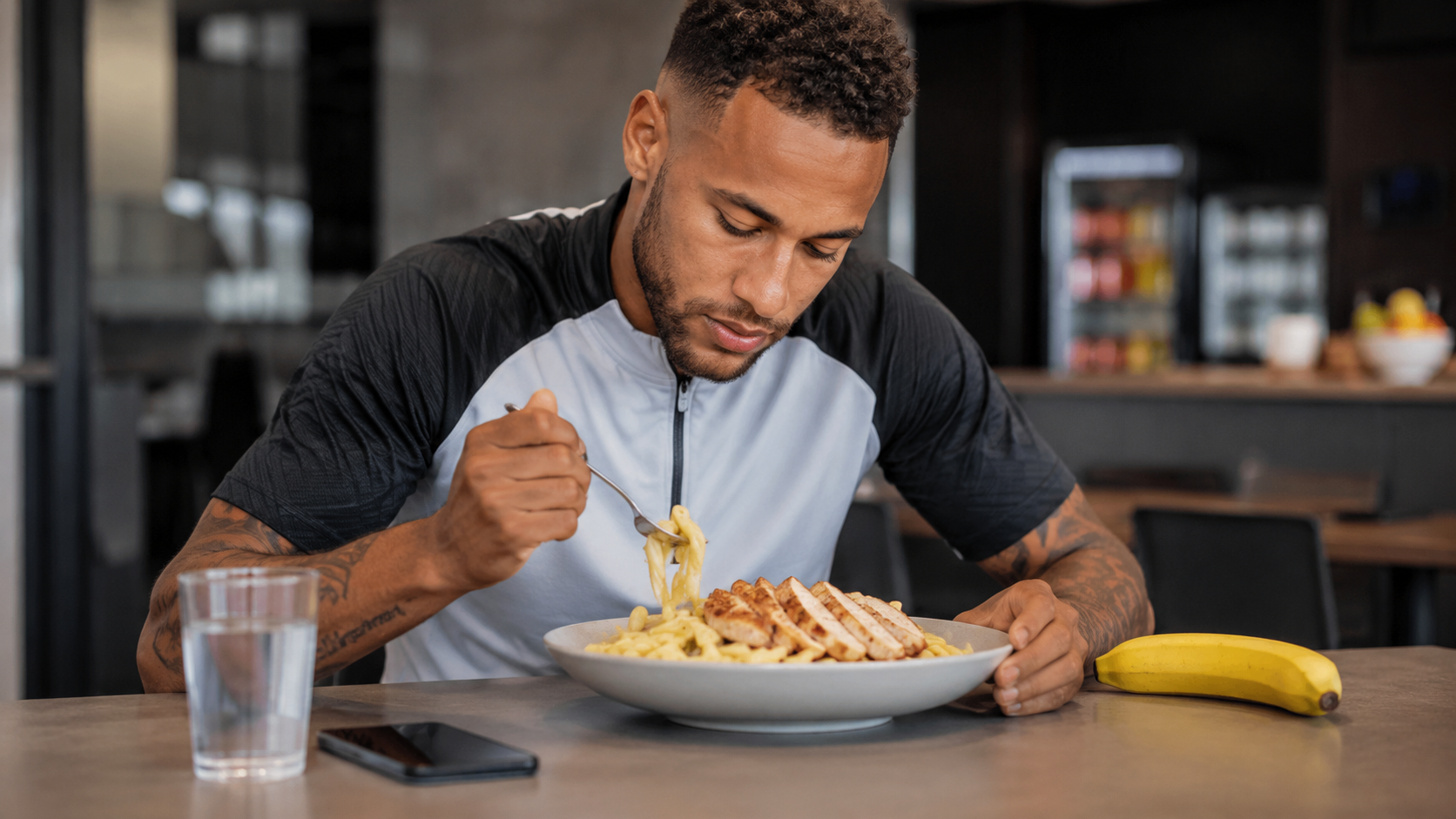
Meal 2: The pregame meal, 3 to 4 hours before kickoff. The Joint Position Stand recommends 1 to 4 grams of carbohydrate per kilogram of body weight in this window. For a 140-pound athlete eating 3 hours before kickoff, that's roughly 130 to 190 grams of carbohydrate. The plate framework is simpler than the math: half the plate carbohydrates (oatmeal, pasta, rice, potatoes), a quarter lean protein (chicken, eggs, yogurt), and a quarter fruit or low-fiber vegetable. A small amount of fat is fine but a meal centered around fat is not.
Meal 3: The pregame snack, 60 to 90 minutes before kickoff. This is the bridge most athletes skip. The main meal three hours out only carries so far and by the time warm-up hits, the body is ready for something to top it off again. A small snack closes the gap: banana, pretzels, toast with jelly, granola bar, a small juice. The standard is mostly carbohydrates, low fat, low fiber, and only foods the athlete has eaten dozens of times before.
Why the Second Half Slips
The second-half fade most parents see in their athlete is rarely a fitness problem. Studies on competitive soccer players keep finding the same pattern. Most are eating about two-thirds of the carbohydrates their body actually needs on game day. The plate looks fine and the meal feels appropriate but the total volume comes up short.
A 2023 study on adolescent international female soccer players found that even at the elite level, athletes were consuming approximately 4.8 grams of carbohydrate per kilogram on match days, well below the greater than 6 grams per kilogram recommendation for intensive training and game schedules. A 2023 study on professional academy male players showed nearly identical patterns.
Soccer is one of the most glycogen-demanding sports in the world. Players cover six to eight miles per match, with the highest-intensity work concentrated in repeated sprints and direction changes. Without enough fuel in the tank, the body protects itself by lowering output. The legs feel fine but the burst goes missing and that’s when the second half slips.
This is a solvable problem. A 2024 study on professional academy soccer players found that athletes who received structured nutrition education successfully periodized their carbohydrate intake to approximately 7 grams per kilogram on match day, meeting the recommendation. A control group remained below 4 grams per kilogram across the entire match week. The difference was not motivation or talent. It was simply put…knowing what to do.
Slow Carbs vs Fast Carbs: The Sleeper Variable
The type of carbohydrate in the pregame meal matters as much as the amount. Recent research using continuous glucose monitoring has clarified what most generalist sports nutrition content still misses.
A 2025 randomized study compared low-glycemic-index pre-exercise snacks (slow-releasing carbs) to high-glycemic-index snacks (fast-releasing carbs) consumed before soccer-specific performance tests. The low-glycemic-index group improved Loughborough Soccer Passing Test performance by approximately 6.4% and Yo-Yo Intermittent Recovery Test distance by approximately 20%. Continuous glucose monitoring confirmed that low-glycemic-index snacks produced more stable blood sugar, while high-glycemic-index snacks produced spike-and-crash patterns.
A 2020 study on simulated 90-minute soccer matches found that low-glycemic-index pregame meals improved late-match agility times by approximately 6.6% and heading jump height by approximately 11% at the 72-minute mark, compared to high-glycemic-index meals delivering the same total carbohydrate dose.
The actual definition of slow and fast carbs can differ between people based on who you talk to. From my perspective what this means in practical food choices for the 3-to-4-hour pregame meal:
Better choices (slower release, steadier fuel):
- Oatmeal
- Pasta
- Rice (brown or basmati)
- Potatoes
- Bread
- Yogurt
- Apples, berries, grapes
Less ideal for the main meal when consumed on their own (faster release):
- Sugary cereals
- Sports drinks
- Energy gels and chews
- Fruit snacks
- Candy
For the 60-to-90-minute snack, faster-release carbs become acceptable because the time window is shorter and the body needs immediate fuel.
The "Healthy Meal" That Backfires
Some of the most common pregame mistakes come from foods that look healthy but slow digestion right when the food needs to move.
A big salad with grilled chicken or granola with yogurt and chia seeds. These are good foods but they are also slow-digesting foods, often higher in fiber and fat than parents and athletes realize. Three hours after eating them, the gut can still be working when the legs are needing the fuel. In this situation the legs feel heavy in the warm-up and the second half is where it really shows up.
The pregame meal is built around a different priority than a regular healthy meal where faster digestion, lower fiber and less fat become the priority. Healthy and game-ready are two different goals, and the pregame meal needs to be the second one.
Pregame Hydration: The Foundation Most Athletes Miss
The pregame meal cannot solve a hydration problem on its own. A 2020 systematic review of 24 studies found that approximately 63% of soccer players arrive at training in a hypohydrated state. Even before games, where players think more about hydration, the prevalence is over 41%, meaning roughly 4 out of every 10 soccer players step on the field for a match already dehydrated.
Pregame hydration starts the day before, not the morning of. The simplest indicator is first-morning urine color. Pale lemonade is the green light meaning you’re in a great spot while a darker color means the day before fell short and some catch up needs to occur.
Practical pregame hydration framework:
- Steady fluid intake the day before, especially with the carb-rich dinner
- 16 to 20 oz of fluid 2 to 3 hours before kickoff with the pregame meal
- Another 8 to 12 oz 30 to 60 minutes before kickoff with the snack
- For high sweat rate athletes or warm conditions, a sports drink with the snack adds sodium
Chugging water in the final 20 minutes before kickoff doesn't fix the day before. It usually creates urgency and discomfort instead.
Common Pregame Fueling Mistakes
The patterns that cost soccer players the second half tend to repeat: Eating too late leaves the food still in the gut at warm-up while eating too little is often a function of pregame nerves shrinking appetite. Fast food and fried meals push fat content past what the gut can handle on game day and can really result in stomach discomfort. Big salads and seeded bowls load up fiber that slows digestion which in a different manner than the fast food still can cause stomach discomfort. Skipping the 60-to-90-minute snack opens a fuel gap by kickoff where we want to capitalize on this time to help keep glucose levels optimized. Trying new foods on game day, especially at unfamiliar restaurants on tournament road trips, is a recurring source of GI distress. Drinking too much water in the final hour to make up for under-hydration earlier creates urgency without resolving the deficit. Replacing the pregame meal with a smoothie alone rarely delivers enough total carbohydrate. Loading on protein when the body needs carbohydrates leaves the muscles short on fuel.
While that seems like a long list of things, most of these are fixable with a single conversation. None of them require an overhaul.
Frequently Asked Questions
What should a soccer player eat 3 hours before a game?
Build a plate with half carbohydrates (oatmeal, pasta, rice, or potatoes), a quarter lean protein (chicken, eggs, or fish), and a quarter fruit or low-fiber vegetable. The Joint Position Stand recommends 1 to 4 grams of carbohydrate per kilogram of body weight in this window. Keep fat and fiber lower to support faster digestion.
What should a soccer player eat 1 hour before a game?
A small snack of mostly carbohydrates with low fat and low fiber works best 60 to 90 minutes before kickoff. Banana, pretzels, toast with jelly, or a simple granola bar with juice all fit. Stick to familiar food the athlete has eaten many times. Game day is not the time to try anything new.
Should soccer players eat protein before a game?
A moderate amount of protein (15 to 25 grams from chicken, eggs, or yogurt) supports satiety without slowing digestion meaningfully. Protein should not be the focus of the pregame meal or snack. Soccer is fueled by carbohydrates. Save heavier protein for the recovery meal after the game.
Why does my soccer player fade in the second half?
The second-half fade is most often a fueling problem. Studies on competitive soccer players keep finding most are eating about two-thirds of the carbohydrates their body needs on game day. The fix is real carbohydrates at dinner the night before, the pregame meal 3 to 4 hours out, and the pregame snack 60 to 90 minutes before kickoff.
Does pregame fueling really start the day before a soccer game?
Yes. Muscle glycogen, the fuel soccer players burn through during a 90-minute match, builds up across the 24 hours before kickoff. Carbohydrates at dinner the night before fill the tank for the next day's game. The pregame meal tops the tank off but cannot refill it from empty.
What's the best pregame meal for a morning soccer game?
Eat 2 hours before kickoff with a smaller, easy-to-digest meal: oatmeal with banana, toast with peanut butter and jam, or a small bowl of low-fiber cereal with milk. The 60-minute snack matters more for morning games since there's less time to digest. Hydration the night before matters more for early kickoffs.
How much water should a soccer player drink before a game?
Aim for 16 to 20 oz of fluid ~3 hours before kickoff with the pregame meal, plus 8 to 12 oz 30 to 60 minutes before kickoff with the snack. Hydration the day before matters more than chugging water in the final hour. A 2020 systematic review found approximately 63% of soccer players arrive at training already dehydrated so the odds are high that this is an area that could be improved upon for you/your athlete.
----------
If your athlete trains hard, eats well, and still fades in the second half, the issue is almost always timing or distribution rather than effort. A free 15-minute Discovery Call walks through what your athlete is actually doing day to day, identifies the one or two highest-impact adjustments, and gives a clear next step. Book here
Jay Short, MS, RD, CSSD is a Registered Dietitian and Board Certified Specialist inSports Dietetics, and co-owner of Rise Nutrition, specializing in sports dietetics for competitive athletes. He works with US Soccer (all 27 teams), the Columbus Blue Jackets (NHL), and athletes across MLS, collegiate, and club programs.
-----------
References
- Thomas DT, Erdman KA, Burke LM. Position of the Academy of Nutrition and Dietetics, Dietitians of Canada, and the American College of Sports Medicine: Nutrition and Athletic Performance. J Acad Nutr Diet. 2016;116(3):501-528. https://pubmed.ncbi.nlm.nih.gov/26920240/
- Collins J, Maughan RJ, Gleeson M, et al. UEFA expert group statement on nutrition in elite football. Br J Sports Med. 2021;55(8):416. https://pubmed.ncbi.nlm.nih.gov/33097528/
- Zuo Y, Poon ETC, Zhang X, et al. Effects of pre-exercise snack bars with low- and high-glycemic index on soccer-specific performance: An application of continuous glucose monitoring. J Sports Sci. 2025;43(14):1397-1405. https://pubmed.ncbi.nlm.nih.gov/40275625/
- Kaviani M, Chilibeck PD, Gall S, et al. The Effects of Low- and High-Glycemic Index Sport Nutrition Bars on Metabolism and Performance in Recreational Soccer Players. Nutrients. 2020;12(4):982. https://pubmed.ncbi.nlm.nih.gov/32252250/
- McHaffie SJ, Langan-Evans C, Strauss JA, et al. Under-Fuelling for the Work Required? Assessment of Dietary Practices and Physical Loading of Adolescent Female Soccer Players during an Intensive International Training and Game Schedule. Nutrients. 2023;15(21):4508. https://pubmed.ncbi.nlm.nih.gov/37960161/
- Carter JL, Lee DJ, Perrin CG, et al. Significant Changes in Resting Metabolic Rate Over a Competitive Match Week Are Accompanied by an Absence of Nutritional Periodization in Male Professional Soccer Players. Int J Sport Nutr Exerc Metab. 2023;33(6):349-359. https://pubmed.ncbi.nlm.nih.gov/37734739/
- Carter JL, Lee DJ, Fenner JSJ, et al. Contemporary educational and behavior change strategies improve dietary practices around a match in professional soccer players. J Int Soc Sports Nutr. 2024;21(1):2391369. https://pubmed.ncbi.nlm.nih.gov/39133100/
- Chapelle L, Tassignon B, Rommers N, et al. Pre-exercise hypohydration prevalence in soccer players: A quantitative systematic review. Eur J Sport Sci. 2020;20(6):744-755. https://pubmed.ncbi.nlm.nih.gov/31526234/

Ready to Take Your Nutrition
to the Next Level?
Stop guessing and start getting results. Book a free discovery call
to find the right coaching program for your goals.